
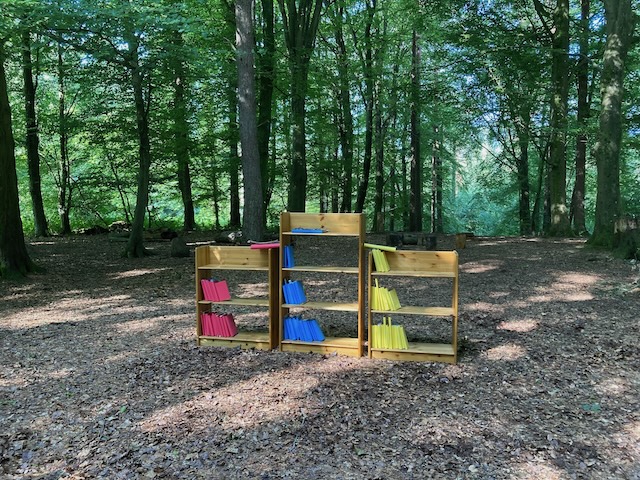
The bookshelf analogy is an important model in the Regenerative Design Lab. And so perhaps you might be asking what is on our book shelves?
Well, when new members join the Lab they get a copy of the Regenerative Structural Engineer, and the Pattern Book for Regenerative Design.
James Norman and I wrote the Regenerative Structural Engineer having read most of the other books on this list below. The book is our attempt to distill all this (and other) thinking and present the concepts in an order that helps us think about how practice as designers (not just structural engineers!).
The Pattern Book builds on this foundation by creating 12 journeys (or patterns) for exploring regenerative design in a wide range of contexts.
But no single book is sufficient. Regenerative practice is plural, evolving and interdisciplinary.
What follows is a selection of texts that have shaped the Lab’s methodology. It reflects one particular intellectual journey rather than a comprehensive canon of regenerative thought.
We will continue to update this list as the Lab evolves and we invite Lab members to share what they are reading to broaden and deepen this canon.
Places to start your reading
*Hopkins, R., 2019. From What Is to What If: Unleashing the Power of Imagination to Create the Future We Want. White River Junction: Chelsea Green Publishing.
How the climate crisis is a crisis of the imagination and what the work is we need to do to imagine a thriving future. A brilliant, far-seeing book, with an excellent podcast series to accompany it.
Kimmerer, R.W., 2013. Braiding Sweetgrass: Indigenous Wisdom, Scientific Knowledge, and the Teachings of Plants. Minneapolis: Milkweed Editions.
This book creates a bridge between Indigenous and scientific thinking. A powerful exploration of reciprocity, gratitude and ecological relationship. The short essay format makes this an easy book to dip into and return to.
*Meadows, D.H., 2008. Thinking in Systems: A Primer. Edited by D. Wright. White River Junction: Chelsea Green Publishing.
A foundational introduction to systems thinking. Even though Meadows does not use the term “regenerative,” her leverage points and mental models underpin much of the Lab’s work.
*Raworth, K., 2017. Doughnut Economics: Seven Ways to Think Like a 21st-Century Economist. London: Random House Business.
The book that launched the model linking social foundations with planetary boundaries, it is full of clear-thinking models for breaking free of the unlimited-growth paradigm.
*Wohlleben, P., 2017. The Hidden Life of Trees: What They Feel, How They Communicate – Discoveries from a Secret World. Translated from German by J. Billinghurst. London: William Collins.
Sheds light on how trees communicate with each other, collaborate and work with shared intelligence. Shows how living systems are interconnected and use feedback loops to respond to environmental change. Helps us shift from an anthropocentric to ecocentric view of how ecosystems work.
Digging deeper into the regenerative theory
Fleming, D., 2016. Lean Logic: A Dictionary for the Future and How to Survive It. Edited by S. Chamberlin. White River Junction: Chelsea Green Publishing.
This book is a whole world! A vast exploration of how we can thrive when resources are scarce. Rich with examples and models that translate well into a regenerative framing. Available also as an online, searchable reference. See https://leanlogic.online
Capra, F. and Luisi, P.L., 2014. The Systems View of Life: A Unifying Vision. Cambridge: Cambridge University Press.
A dense but fascinating synthesis of biology, physics and systems theory. Great for delving into how living systems actually function.
Mang, P. and Reed, B., 2012. Regenerative Development and Design: A Framework for Evolving Sustainability. Hoboken: John Wiley & Sons.
An incredible practical guide to regenerative architecture with a particular focus on place-based design.
Pawlyn, M. and Ichioka, S., 2021. Flourish: Design Paradigms for Our Planetary Emergency. London: Triarchy Press.
Explores regenerative design from different paradigms and introduces in particular the idea of ‘possibilism’, an important framing for shifting the way we think about the future we want to build. Another book with an excellent podcast series to accompany it.
Wahl, D.C., 2016. Designing Regenerative Cultures. Axminster: Triarchy Press.
A definitive systems-based regenerative text. Demands confidence in systems thinking but rewards deep engagement.
Practice, play and attention
Bridle, James., 2023 Ways of Being : Animals, Plants, Machines: The Search for a Planetary Intelligence. Penguin.
A fascinating exploration of intelligence – from how we make sense of our multiple internal intelligences, to how ecosystems think. I really important book for challenging how we think about design.
Crawford, Matthew B. 2015 The World Beyond Your Head – How to Flourish in an Age of Distraction. Viking.
Explores the limits of what we can know, and how we need to submit ourselves the system problems we face. A wonderful book to keep returning to.
Gaulier, Philippe. 2020 The Tormentor (my thoughts theatre). Editions Filmiko.
Philippe Gaulier’s teaching has helped shape the Lab’s emphasis on presence, sensing the audience and avoiding pre-meditated solutions. This creates a powerful metaphor for the role of the designer and the audience: who is on stage and who is the audience?
Wright, John. 2006 Why Is That so Funny? A Practical Exploration of Physical Comedy. 2006.
Play is such an important part of our facilitation. It connects, it unlocks, it challenges power and dares us to see things differently. John Wright’s book is valuable compendium of techniques for facilitating playful encounter.