Use the water on its way downhill

Use the water on its way downhill

Gather the feedback before everyone leaves.

Capture the waste heat before it disappears up the exhaust.

Better to hear it from the horse’s mouth.

Hold the nutrients back before they are washed away down the mountainside 

Learn the lesson straightaway 

Reuse before you recycle

Sort it on the doorstep rather than at the dump.

A bird in the hand is worth two in the bush

When in doubt take the high road.

You can’t stop the waves but you can surf them.

When something concentrated disperses, it loses its potential. Dispersal is inevitable. The skill in regenerative design is to catch the potential on its way down, and cycle it into new life before it’s gone

On packing cubes and better fit

Fold everything up and put it straight in the bag? Or fold everything into packing cubes first, then put these in?

Not an important dilemma — but useful for thinking about utility and fit.

Packing cubes make it easier to find your stuff. That’s a win for utility. But they make it harder to use space efficiently. That’s a loss of fit.

When you pack directly into the case, clothes can mould to the contours of the bag. With cubes, you’re first fitting clothes into rigid boxes, then trying to fit those boxes into the bag. The bigger the chunks, the less well they fit.

Even cubes designed for your bag add extra cell walls. It’s more work to get everything in.

Why does this matter? Because it’s all about equilibrium. The more options a system has, the better it can settle into a state that fits its surroundings.

Of course, both bags — with cubes and without — are at equilibrium once zipped. But cubes trap the system in a constrained equilibrium: ordered, but with wasted potential (unused space). Without cubes, the system has more freedom to find a messier equilibrium that actually fits better.

And there’s entropy at play: to keep clothes in neat cubes takes extra work. Left free, they tumble into arrangements that fit themselves.

From a regenerative point of view, sometimes it’s worth adding structure — boundaries, hierarchies, rules — to make a system function. But structure always reduces adaptability. Keeping a system in a fixed order takes work, and wastes some of its potential to respond.

So the design question is: when is it worth doing the work to hold things in order, and when is it better to let the system find a looser, but better-fitting arrangement?

The Entropy Bus

When strangers get on a bus, they almost always spread out. Few people sit next to each other unless they really have to.

Partly that’s social norms. And partly it’s probability — and entropy is the name we give to it: the measure of how many possible configurations a system can take.

The social rules push people apart, but entropy makes the scattered state the most likely outcome.

You could put an extra conductor on the bus to tell people where to sit, filling rows neatly from the front. But that takes energy. Take the conductor away, and inevitably everyone spreads out again.

The lesson of the entropy bus is that order is costly, disorder is cheap — and dispersal from order to disorder creates a flow.

The art of regenerative design is to shape systems so that the most likely outcome, and the flow in that direction is also the most life-giving.

Boltzmann laughter distribution

This week I’ve been playing around with a way to explain the Boltzmann distribution — a mathematical function that predicts how energy is likely to spread out in a volume of gas. 

Imagine you have an audience of 100 people. Imagine there is a fixed amount of laughter to go around. What’s the most likely way the laughter will be distributed in the audience. 

Now, already I can see this analogy breaking down. But let’s just go with it for a little longer. 

We could arrange things so that one person does all the laughing. As there’s 100 people in the room, there’s 100 different ways we could do this: one for each possible solo laugher. 

Now imagine  we have two people laughing each with half the total available laughter. There are now 4,950 ways to pick those two people — in other words 4,950 ways to pick two people from 100.

The more we spread the laughter around, the more ways there are of distributing that laughter. 

The equation is for an audience size of n, and the number of people laughing in the audience, the number of ways of arranging laughter is n!/(k!(n-k)!).

This number of combinations gets very large very quickly. For half the audience laughing, there are approximately 100,000,000,000,000,000,000,000,000,000 ways of doing this.

This idea — the some arrangements have more ways of being achieved than others — is what underlies the Boltzmann distribution. 

Introducing some more formal language:

A macrostate is the overall situation (eg half the room laughing)

A microstate is one specific way of achieving that macrostate (eg exactly which 50 out of the 100 are laughing). 

Now, energy in a system doesn’t decide which microstate to be in. It just jostles around between different microstates. Some energy here, some energy there. But since there are far far more ways of achieving the more distributed macro states than the ones where energy is concentrated, the system almost always ends up in a highly distributed macro state. 

The macrostate with the most microstates is overwhelmingly likely.

This is why energy spreads out in a room. It isn’t a plan, it is just the macrostate that is overwhelmingly more likely. Like billions and billions of times more likely. 

This concept underpins ideas like equilibrium, itself an important underpinning idea in regenerative design. The goal of regenerative design is for humans and the living world to survive, thrive and co-evolve — in other words, thriving in equilibrium.

Of course, any physicists listening to this would laugh me off stage. For one thing, laughter isn’t a fixed quantity. And for another, one person’s laughter can trigger more. And…one person laughing amongst 100 is in itself funny. 

Now if there were 100 physicists in the room…how many would be laughing?
Blowing hot air

One of my favourite design features at the Barbican Arts Centre is in the loos: a row of round sinks, set into polished concrete, with taps activated by foot pedals. It’s elegant, low-tech, and fun to use.

It got me thinking about bathroom design more generally — and how, every now and then, designers like to reinvent the tap.

Which brings me to the Dyson Tap. Water and hand-dryer in one. Sleek, modern, cropping up in more and more public toilets, and every time I use one, I get it wrong.

These newer designs are often accompanied by diagrams on the wall explaining how to wash your hands. That’s a warning sign. A well-designed object shouldn’t need instructions — it should feel instinctive, especially for something as routine as a tap.

We’re used to how taps work: anticlockwise for on, clockwise for off, hot on the left, cold on the right. This cultural code runs deep. And when a design ignores it, it has to work even harder to be intuitive.

But here, nothing is familiar. The shape suggests “dry now” before I’ve even washed. Then I trigger the dryer accidentally mid-wash. 

Then I try to find the soap. A different machine. Often it’s not working, and someone’s helpfully plonked a bottle nearby (you can just see the pink glow of one in this photo).

It makes me wonder: what problem is this trying to solve? Maybe a regular tap would be simpler, more durable, lower in embodied energy — and a better cultural fit.

Which takes back to the foot-operated taps at the Barbican. These were different but didn’t have a instructions. Somehow, this new design must have just worked.

Too long/too late?

“Due to short platforms, the doors in the rear carriage will not open at the next station.”

Whenever I hear this train announcement, I wonder if they could just as well say:

“Due to long trains, the doors in the rear carriage will not open at the next station.”

It’s a matter of perspective.

According to research published by the Get It Right Initiaitve, one of the most common root causes of construction errors is late design changes.

But I think it is important to ask: is the design really late — or did construction start too early?

With pressure to show progress and get contractors on site, many projects begin before the design is ready.

But then again, maybe that’s just a matter of perspective.

Branching out (and clash detection)

I read this in the Hidden Life of Trees.

In a woodland canopy, if two trees of the same species are growing near to each other, their branches won’t overlap.  

But when different species of trees grow side-by-side, they do compete and overlap. 

This incredible. When the tips of tree branches approach one another, they somehow know, and take the most appropriate action. Without drawings, without meetings and with BIM (building information modelling). They sense, respond and coordinate — in realtime and and mid-air. 

Contrast this with a modern, multidisciplinary design team trying to avoid clashes between all the interlacing systems in a building. Even with powerful computer models we find it difficult for one building system not to bump into another. 

The living world makes coordination look easy. 

Cabin in the woods (a preview)

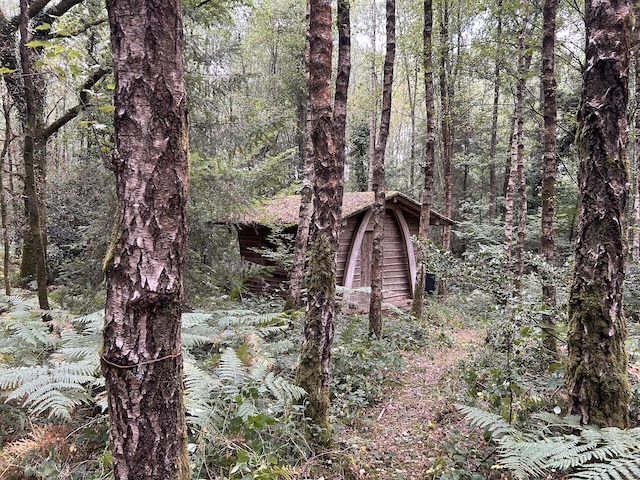
Tucked between Douglas Fir and regenerating birch, there’s a small green oak cabin at Hazel Hill Wood. From its windows and door, all you can see is woodland. 

The cabin was gifted to the Trust by our founder, Alan Heeks, and yesterday I worked with a group of volunteers to give it a spring clean. We’re hoping to bring it back to life — maybe as a writer’s cabin, maybe a solo retreat space.

I can vouch for it as a place to write. This is where I drafted the Critical Thinking training for Useful Simple Trust (some of which made it into the Pattern Book for Regenerative Design). It is also where I have written many blog posts. 

In time, I’d love to see team leaders or designers using the space — staying a night or two and putting their plans through a series of regenerative prompts. And they might not even need the prompts, as the wood seems to ask questions of you the more time you spend there. 

The cabin still needs a few upgrades, and we’re thinking of launching a crowdfunder to help make it happen. If a solo professional retreat in the woods sounds like your kind of thing, let me know.

Don’t scale up — scale right

There are no factories in the living world. Or at least if there are, they are very well camouflaged. 

Humans, by contrast, are very attached to factories. By reducing variation and tightly managing the handover between every step of the process – in other words, the relationships – assembly lines can be optimised for throughput.

Profit is often linked to throughput. Both in terms of the per-unit mark-up on a manufactured item, and in terms of dividing fixed costs, the more you make the more money you make. 

And so standardisation becomes the driving factor. Standard inputs, standard processes, uniform outputs. Each variation brings costs and lowers profits. 

Looking out across the understory here at Hazel Hill Wood, I see a certain degree of standardisation. The only plants I see are birch, holly, Douglas Fir, bracken and bramble. But go to a different part of the wood and the variation and balance of species will be different, depending on the specific variations of that location. In each location, the wood finds the best way it can to grow harmoniously. And in each location, that is slightly different.

The regenerative designer seeks to work with that specific variation, not because of some nostalgia for smaller scale construction, but because they recognise the greater potential value that can be unlocked from working with variation. 

Variation does not work at scale. When large teams need be kept up-to-date and coordinated around changes, then the admin overhead quickly balloons. 

All this points towards construction models built around smaller, agile teams—able to turn the specific variations of place into an advantage. Creating designs that are more harmonious (and therefore with fewer hidden costs). And unlocking local, positive feedback loops that strengthen the local economy and ecology. 

If your goal is throughput, scale up. But if your goal is to maximise value across business, ecology and community — then find the scale that lets all these systems flourish.

Scale up for throughput, but scale right for thriving.

On scale, specialisation and life beyond pins

One of the commonly-cited benefits of scaling-up an operation is to enable individuals to specialise

Adam Smith famously argued that a pin factory, where each worker focused on specific step of the pin-manufacturing process, far more pins could be made than if each worker made whole pins on their own. 

This example has become one of the key doctrines of classical economics. But I find the example disingenuous. 

Firstly, because it is not like before Adam Smith came along there were halls full of pin makers unproductively making pins on their own. More likely, there were people who could make pins — and they could also make a host of other ironmongery — because they skilled in metalwork and a broad range of related skills. 

Life doesn’t just need pins. 

Second, his pin factory only works under a specific set of conditions. 

To make the most of each specialised worker, there must be no bottlenecks from one step to the next. Workers must work in shifts to maintain flow. There can be no variation in output. Input materials must be reliably supplied. Environmental conditions must be tightly controlled. And there must be a constant supply of customers, all buying pins.

But meeting all of these requirements, this now large-scale enterprise starts to exert a gravitational pull of its own. It shapes when, how and for how long people work. Like a giant magnet, supplies of iron are sucked into it. And it shapes what people consume — more pins. 

Scaling up does enable specialisation. And specialisation can increase productivity. But we mustn’t leave the wider costs of specialisation out of the denominator on the productivity equation. 

The regenerative designer asks, not how can I scale up, but how can I find the scale of operation that enables the most parts of the system to benefit?