
How do we know if we are moving forwards?

Facilitation is an intense business. It requires you to read lots of social cues and to judge what’s the best next step. It’s not surprising therefore that when travelling home in the train from a workshop I usually drift off, the sway of the carriages gently quickly sending me to sleep.

And it was in that just-before-sleep moment that I realised I had no way of knowing if I was moving forwards or backwards. Once the train had reached a steady state there was no impulse forwards or backwards, just the jostling and shaking of the carriages. With my eyes closed, I couldn’t see. And it was dark outside in any case. For all I knew we could have been stationary and just shaking on the spot..

Cue a metaphor for how we perceive change. If we are in the daily hustle and bustle of delivering projects, all we feel is the shaking and the jostling. If we can’t see into the distance we can’t see if we are getting closer and further away.

Back in the train, when the driver accelerates we feel pushed in to our seat (or pulled slightly out if we are facing backwards). But acceleration in organisational systems change is often much more imperceptible. We might not know it until things get out of control or ground to a halt.

So what can we do? Try this:

  • Ask what would it means to see the horizon? Maybe it’s something external to your daily frame of reference. Are you getting closer or further away?
  • Ask what it would it mean to see the rate of change? This might mean trying to find some sort of trace. Eg – Invoices, customer queries, sick days, species count, maintenance outages. How does that of these compare to last year?

If we can access these external frames of reference, we can start to understand our direction of travel, speed and acceleration.

The Living Systems Blueprint is our tool for assessing progress towards regenerative systems outcomes. Its three components – interconnection, symbiosis and capacity to change – give us a direction of travel and a framing for assessing progress.

Whether you use this framing or a different one, we need external reference to check our progress. 

Without them we might just be busily shaking on the spot.
Three Horizons facilitation (90 minutes) — sometimes all people need is the picture

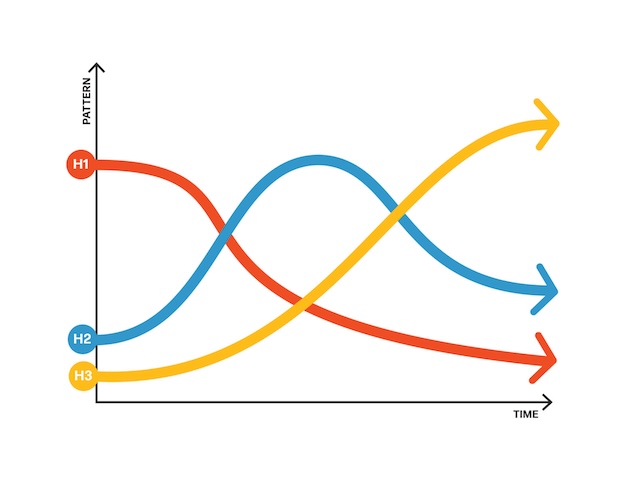
Diagram of the Three Horizons model with three overlapping curves labeled H1 (red), H2 (blue), and H3 (yellow), showing how different patterns rise and fall over time.

The Three Horizons model is one of our key tools in the Regenerative Design Lab for exploring change. It’s simple enough to grab in a short space of time (see yesterday’s post on a the fit of a good tool), but deep enough to shape a deep, long-term exploration. For example we use the Three Horizons to create the arc of the Lab — in which we start with dreaming about a thriving future, return to the realities of the present, and then going on explore the steps that can create a change from one to the other.

The model also supports a half-day deep dive into innovation (See Kate Raworth’s excellent 6-minute video on facilitation questions to support such a process.)

But sometime the greatest value I see is in simply getting people familiar with the picture. If people can see the three mindsets — the manager (H1), the dreamer (H3) and the entrepreneur (H2) — the conversation can open up by itself.

Below is a 90-minute introduction I’ve been using. It gives people just enough structure to try on the model, and then lets them get on with using it. This is how it goes.

Three Horizons: 90-minute facilitation plan

Getting started

00h00  — Arrivals (10mins)

For the usual how-do-you-dos, and-I’m-sorry-I’m-lates. 

00h10 – Warm-up (5mins)

Ask people to write down on post-it notes as many cool sustainability (or whatever topic you are interested in) initiatives as they have heard of on separate post-it notes. Requirements:

  • It must exist in the real world or as a prototype
  • Or it must have a website. 

You don’t need to say this but we’ll use these later to populate Horizon Two.

00h15 — Introduce the model (10mins)

Acknowledge the familiar dynamic:

  • Dreams of the future
  • Frustrations with the present
  • Lots of opportunities pop up, but it’s hard to know where to start. 

Introduce the Three Horizons as a way to see all of three simultaneously. 

Step 1 — Horizon Three: the future we want

00h25 Breakout (10mins)

Prompt questions: 

  • What are your hopes, dreams and values?
  • What future would be proud to hand on to future generations?
  • What elements of that future already exist?

Get participants to stick their post-it notes to the top right of the diagram.

00h35 Plenary (10mins)

Explore the different responses about the future. 

  • What was easy and hard to discuss?
  • How did it feel to talk about the future?

Step 2 — Horizon One: Our reality

00h45 Breakout (10mins) 

Prompt questions: 

  • What holds your attention?
  • What keeps the current system in place?
  • What is causing pressure for change?

Get participants to stick their post-it notes on the left of the diagram.

00h55 Plenary (10mins)

Explore the different responses about the present. 

  • What was easy and hard to discuss?
  • How did it feel to talk about the present?

This is the part of the process that my colleague Will Arnold would refer to as the Pit of Despair — when hope goes out of the room. It important to acknowledge this, and to welcome in Horizon Two as a way forward.  

Step 3 – Horizon Two: The ideas that move us forward

01h05 Breakout (10mins)

Prompt questions:

  • What steps could move us from H1 to H3?
  • Which of these opportunities already exist (you can use entries from the warm-up exercise as a prompt)

01h15 — Plenary (10mins)

Explore:

  • Which ideas act as stepping stones?
  • What conditions will enable these seeds to grow?
  • Who else needs to be involved?

Closing

01h25 – Conclusions (5mins)

  • What does the overall picture reveal?
  • How could use the model in your own work?

As a final signpost, I refer people to the Three Horizons entry in the Pattern Book for Regenerative Design and in our free online Tools for Regenerative Design. 

01h30. Close.

Why this format works

This short workshop format gives participants:

  • A felt experience of each of the mindsets
  • A shared map of their collective thinking and their shared reality
  • Provides just enough detail to get people familiar with the model so they can use it in more depth themselves. 

Overall I think it shows what the Three Horizons does best:  to help people hold the future, the present and the opportunity for change all at the same time.

Field notes: trying on the Systems Change Lab for size

Last week I had the privilege of facilitating an afternoon session for the Engineers Without Borders UK Systems Change Lab in London.

This is such a powerful initiative. It is an action-led community whose purpose is to make global-responsibility the norm in engineering. In their previous meet-up in Birmingham, participants had designed a new community structure. My role this time was to bring that structure to life so people could feel how it might work in practice. 

The community structure has three levels of engagement: 

  • membership; 
  • action groups that self-organise around specific themes; and 
  • a steering group. 

Sounds great — but does it feel like? How might it work? Where do people see themselves fitting in?

Three-part facilitation

Affinity Clustering

We began with one of my favourite warm-ups — walk around the room, catch someone’s eye, do a little hop — to set the playful tone from the start. 

Then came affinity clustering. Participants walk around the room with a large sticker on their chest saying a topic they are interested in exploring in the lab. The aim is to congregate with people with related themes. I called ‘twist’ a couple of times to give players the chance to try out different group configurations before settling where they felt the strongest pull

Simulating an action-group meeting

Newly formed grouped explored their shared interests and how they could collaborate to take action on this theme. Each group chose someone to be their representative at the steering group meeting.

A steering-group fishbowl

The representatives from each action learning group gathered to form the steering group, and held a live meeting in the middle while others observed. Onlookers outside the fishbowl could pause the conversation and offer reflections. 

Across these three stages the community structure came to life. People could feel the dynamics, understand the logistics and make suggestions for how to make it better. 

The fishbowl in particular opened up important early questions: 

  • How much autonomy should the action groups have?
  • How much should the steering committee  steer or respond?
  • How does information get communicated across the whole Lab?

These are important questions in any organisations, but particularly ones that are action learning and self-coordinating. 

If you’re interested in the EWB-UK Systems Change Lab, you can join their mailing list here:

Facilitation technique: The Fish Bowl

The fish bowl is facilitation technique that enables a large group of people to observe a small group. The small group sit around a table and discuss a topic. The participants in the small group hold a discussion around an initial topic. A chair person holds the space, making sure people are contributing appropriately and adding their own observation. 

Standing around the small group are the rest of the audience. They are not allowed to contribute or interrupt. 

Once the small group has had some time discussing the topic at hand, the session facilitator calls cut, and asks the rest of the audience to comment on what they have observed. What did they see emerging from the conversation. What would they like to see the group discussing next. How would they like chair to facilitate the next part. 

The facilitator then instructs the chair on how to proceed. This switching between the small group and large group can go back and forth a few times until the session has met its aims. 

The Fish Bowl is good for exploring both what people talk and how they talk about it. By giving the opportunity to pause, reflect and direct the conversation differently, we get to see how different factors influence the conversation. 

I’m so glad I came to your meeting

What would make someone say this?

How you greet them?

The thought you put into the structure?

Checking what they need to participate?

The care in deciding who attends?

The discipline and generosity in how you facilitate?

The biscuits?

Whatever it is, when your attendees are glad they are there, they can participate more happily. And when we are happy we can see more possibility. More potential. Willing to take a risk and propose something different.

But when gladness disappears, the creative shutters come down, and with them the possibility of a worthwhile session together.

So, what will make your participants say, yes that was great, I’m so glad I came to your meeting?

Field Notes — The Agora

This week I facilitated the final sessions in our Critical Thinking series for the Useful Simple Trust.

The programme takes participants through four rooms in the mind of a critical thinker. We began by gathering data in the Observatory, analysing these inputs in the Map Room, and then deciding between courses of action in the Decision Engine.

This final stage is called the Agora, from the Ancient Greek for marketplace. This workshop is about stepping into the public square to speak persuasively.

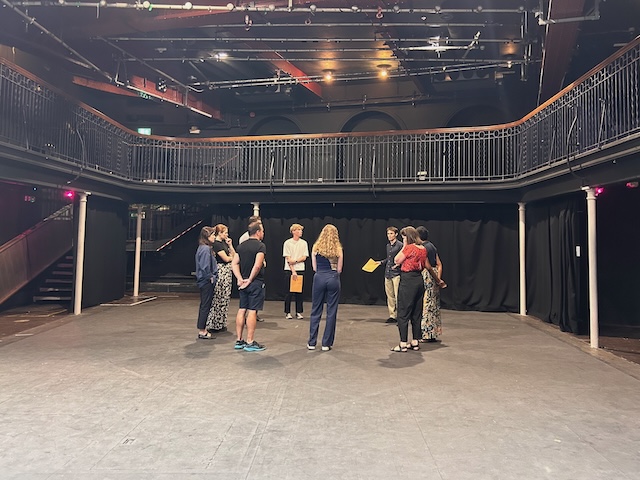
We held the sessions in a real theatre—a technique I first experienced 16 years ago on a training course with Linda Meyer, when I began working at the Useful Simple Trust.

But before we stepped on stage, we began in Catalytic mode— a conversational style I learned from Nick Zienau on another formative course. Catalytic Style builds trust and empathy — two essential elements of persuasive communication.

The final piece in this persuasion triptych is clarity. For this, we used the stage itself—moving across it to physically map out our key points and structure an argument in space.

To conclude, participants gave short presentations that drew on key insights from across the programme, using techniques from the workshop to build compelling, well-structured arguments grounded in critical thinking.

With the final curtain drawn, the ball is now in the court of the participants. The real work begins in applying this thinking to daily practice. That’s when the hard work starts — but as we like to say at Constructivist, you only learn when you do difficult things.