
Flops — the aérotrain

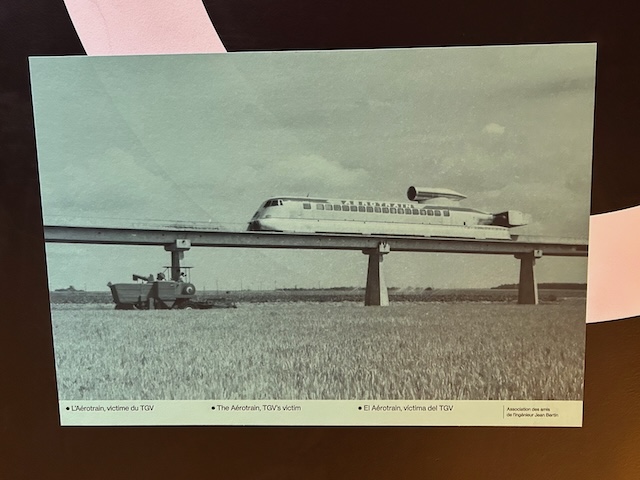
I snapped this photo of a photo at the Flops?! exhibition last month at Paris’s Musée des Arts et Metiers. The exhibition explores the importance of failure in design. Which is an important topic, for another day. For now I just want to share how much I love the story of the aérotrain.

The train floats on cushion of air, like a hovercraft. At the time, British Rail was experimenting with similar floating trains, generating forward propulsion using magnets (you can still see the prototype outside Peterborough station, on the left-hand side as you enter the station going north). The French team were trying something different: strapping a gas turbine engine onto the roof. The prototype reached speeds of over 400km/h!

But jet powered floating trains weren’t to be. Despite positive results from early experiments, the existing industrial railway establishment wasn’t going to tolerate this incursion into its territory by the aerospace sector. The aérotrain experiment was cancelled in favour of the now familiar TGV.

But the traces of this audacious experiment remain — the track still runs parallel to the train from Paris to Orléans, an abandoned piece of futuristic infrastructure from the past. But I love these — they are a symbol of the power to imagine something different, even if it didn’t work out that way.

Everything had to change for everything to stay the same

This is the key line in one of my favourite films, Visctonti’s 1963 The Leopard

Based on the novel of the same name by Giuseppe Tomasi de Lampedusa, the film follows the life of the Prince of Salina during the unification of Italy in the 1860s. 

Rather than fight the revolution, he goes with it, because he senses that after the revolution the old power hierarchies will remain. 

‘Everything had to change for everything to stay the same’. 

This line could sound fatalistic. But I take it as a warning not to be complacent when we see change coming. Change might signal  the dismantling of the status quo. Or it could simply mean the current system rearranging itself to maintain power. 

How can we tell the difference? 

Well, we can spend time thinking about what the future is we want to build. What are values? How is it wired together? What would thriving look like?

In the Toolkit for Regenerative Design, two models help with this”

  • Changing Mindsets — how our worldview shapes the systems we create
  • Living Systems Blueprint — the characteristics of systems that create thriving over time

When we have clarity, then we can scrutinise the latest novelty and ask:

is it a path to better, or is it a path to more of the same?

The dance of innovation or dancing on the spot

Regenerative design aims to shift our system of design and construction to one that creates thriving. 

But when we are working with an incumbent organisation — one built around the current way of doing things — a big question often arises: 

How do I know if I am really making change?

When organisations are heavily invested in the current system, genuine change is rarely part their short-term strategy. 

An avoidance strategy then is to perform the dance of innovation — creating the appearance of transformation while continuing with business as usual. 

Like a magician waving one hand while hiding the real trick with the other: 

Well, you know, we’re really committed to change and we’ve got these great consultants in, and they’re figuring out the strategy… so for now, we’ll just carry on.

For change-makers looking to shift the mainstream, the chance to work with a major supplier or client can feel too good to pass up. But we have to stay alert to innovation being a delaying tactic.

It may look like progress, but if nothing changes under the surface it’s really just dancing on the spot.