
Starting to see the system

Yesterday we kicked off our new introduction to regenerative design, ‘Seeing the System’. 

The premise is simple: seeing more clearly the systems we are working with as a precursor to changing them for the better.

The system of drawing plans, mining materials, fabricating components, pouring foundations and assembling all these elements to create buildings and infrastructure — the system we call construction — is currently wired to cause net harm. 

Yes we create buildings, yes these buildings for the most part are beneficial, but the side-effects are major contributors to climate change and ecological destruction. 

To understand why, we have to see the system. 

  • What kind of systems are we dealing with?
  • What are the feedback loops that reinforce the way the system works?
  • How is the system organised?
  • How do materials and energy flow?
  • What is the system optimised for?
    What are the mindsets that govern our behaviour as well as our dreams?

Then we can start to ask what if that system were different? What if every time we built something, the places that were touched by that process were better off? Habitats enriched, communities enhanced — all through the act of design and construction. That’s the goal of regenerative design.

Seeing the system helps us to interpret this dream, compare it to reality and then help us figure out what step to take next.

We’ll be running another edition of Seeing the System in the spring — stay tuned for more info.

Getting on with regenerative design

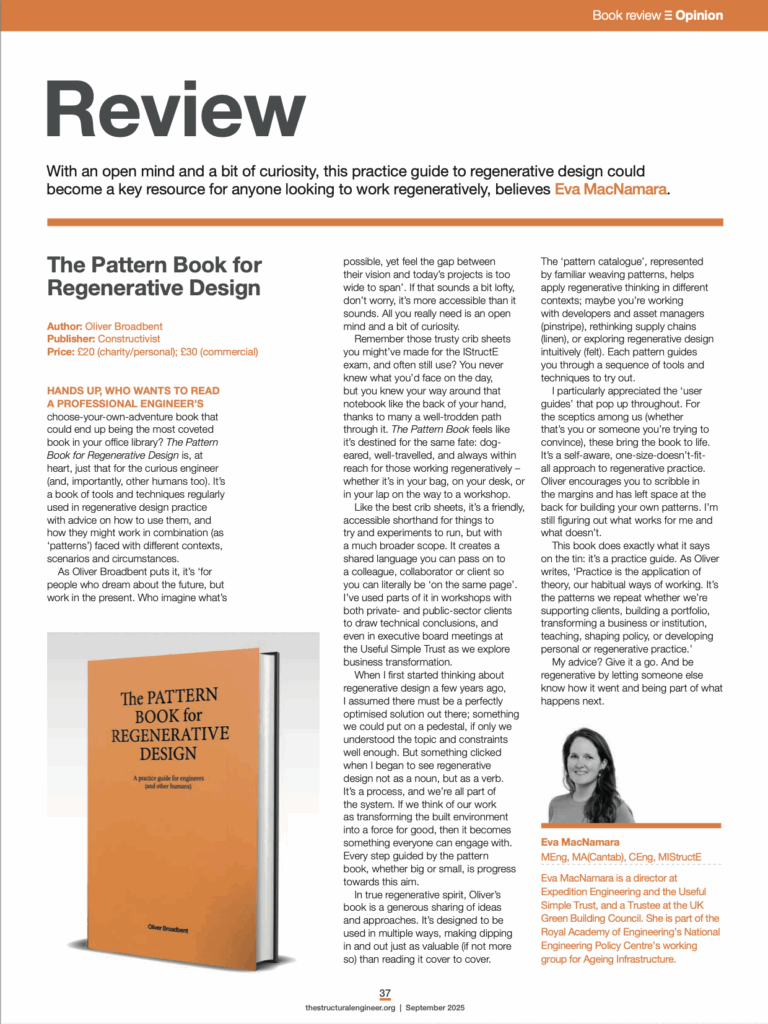
Earlier this month, the Structural Engineer magazine published a review of the Pattern Book for Regenerative Design by Eva MacNamara, Director at Expedition.

Screen shot of a book review in the Structural Engineer ,with an image of the Pattern Book for Regeernative Design on the bottom left and a by-line of the reviewer Eva MacNamara on the bottom right

What I loved about Eva’s review was the way she captured the Pattern Book in use.

Dog-eared, well travelled and always within reach for those working regeneratively — Whether that’s in your bag, on your desk, or in your lap on the way to a workshop

It is, after all, a practice guide — and practice is those regular repeated actions that make up our days. 

It complements another reflection I’ve had this week. 

As we put in place plans for our three cohorts of the Regenerative Design Lab next year, how much the dialogue has shifted since we began. Back in 2023 a lot the discussions were about what regenerative design is, how to make the case for it, looking for examples. 

Whereas now, the conversations that I hear are much more engaged in practical application. How to embed this thinking in different scenarios. How to seek out new opportunities to make change. How to weave a regenerative approach into early-stage thinking on a project?

This is about getting on and doing. 

It’s about experimenting and learning.

This is about practice. 

Just a reminder — there’s seven weeks to go until we launch our online intro to regenerative design, ‘Seeing the System’. Do let your colleagues know. Previous Lab members have a discount code that gives 20% off for their colleagues.

Our new online intro to regenerative design launches in November

Here’s my pitch:

Interested in regenerative design?
Are you — or your colleagues — wondering how to introduce regenerative thinking on a live project?
Would a short course help build clarity and confidence, and give you a few practical tools to get started?

Would you like to sign up to Seeing the System, our new short online introduction to regenerative design, starting 12 November?

See what I did? It’s a classic ‘yes spiral’. One from the basic toolkit of advertising. But what this course aims to give you is a different toolkit: the basic tools of regenerative design.

Over four two-hour sessions, we’ll explore the core tools from our regenerative design toolkit. As you’d expect, the course will be delivered in our usual, engaging style — with space for reflection, peer learning, and short practical tasks between sessions to help apply the ideas to real work.

Seeing the System is part of our plan to grow how we teach regenerative design. Alongside the Regenerative Design Lab, this short online format offers a gentler starting point — ideal for those who want to explore the ideas without committing to the full Lab experience.

Are you sold?