
Machine work

Inputs

Outputs

KPIs

Tools

Models

Performance

Quantitative analysis

Scaling up

Accelerator

Dashboard

Timesheet

Human resources 

Bottom line 

When we think of our work as the work of a machine, then is it any surprise that the incredible machines that we have built will one day starting doing it for us.

But we do ourselves a disservice if we only think of ourselves in machine terms. If we leave out empathy, care, collective knowledge, grounded understanding of place, knowing that is not describable in words, trust, passion, play… then we are not bringing our whole selves to the work we need to do. 

There are so many more ways of knowing than the knowledge we can enter into a computer. Let the computers do the computational part – they will be very good at it – and let us step into our wider intelligence as engineers (and other humans).

This blog post was inspired by Reinventing Organizations, by Frederic Laloux. 

This post originally appeared on eiffelover.com in September 2024.
Core tools for regenerative design now online

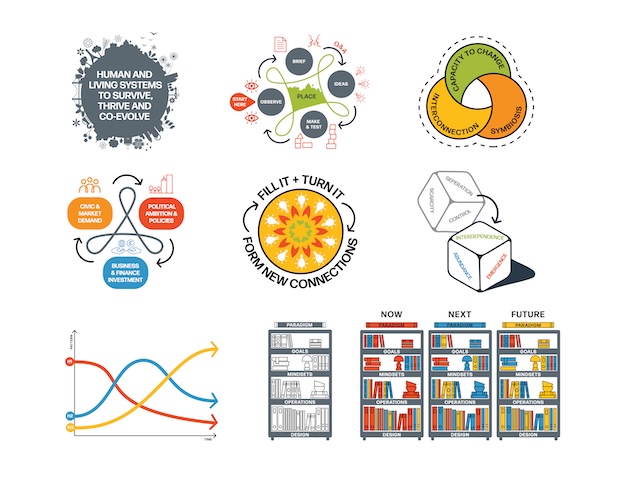
9 thumbnail-sized illustrated diagrams providing an over of the 9 constructivist tools for regenerative design. The tools are the ambition loop, changing mindsets, the goal of regenerative design, continuous place-based design, the living systems blueprint, the systems bookcase, the library of systems change, the three horizons and the kalideascope.

I am happy to announce that we have now published online our set of free-to-use core tools for regenerative design. These nine tools are central to our teaching in the Regenerative Design Lab

Accompanying each tool is a free-to-use downloadable image, designed by Alexie Sommer, who led the design of the Pattern Book and all our visuals at Constructivist. 

As well as the motif description from the Pattern Book, each tool has linked to it recent blog posts that relate to that tool’s function. In this way, we have aimed to create a set of core reference content that dynamically update as we conduct new experiments with these tools.

By publishing this toolkit we hope we can spread these ideas further at the same time as drawing more people into this work. So please do check them out and spread the word.