
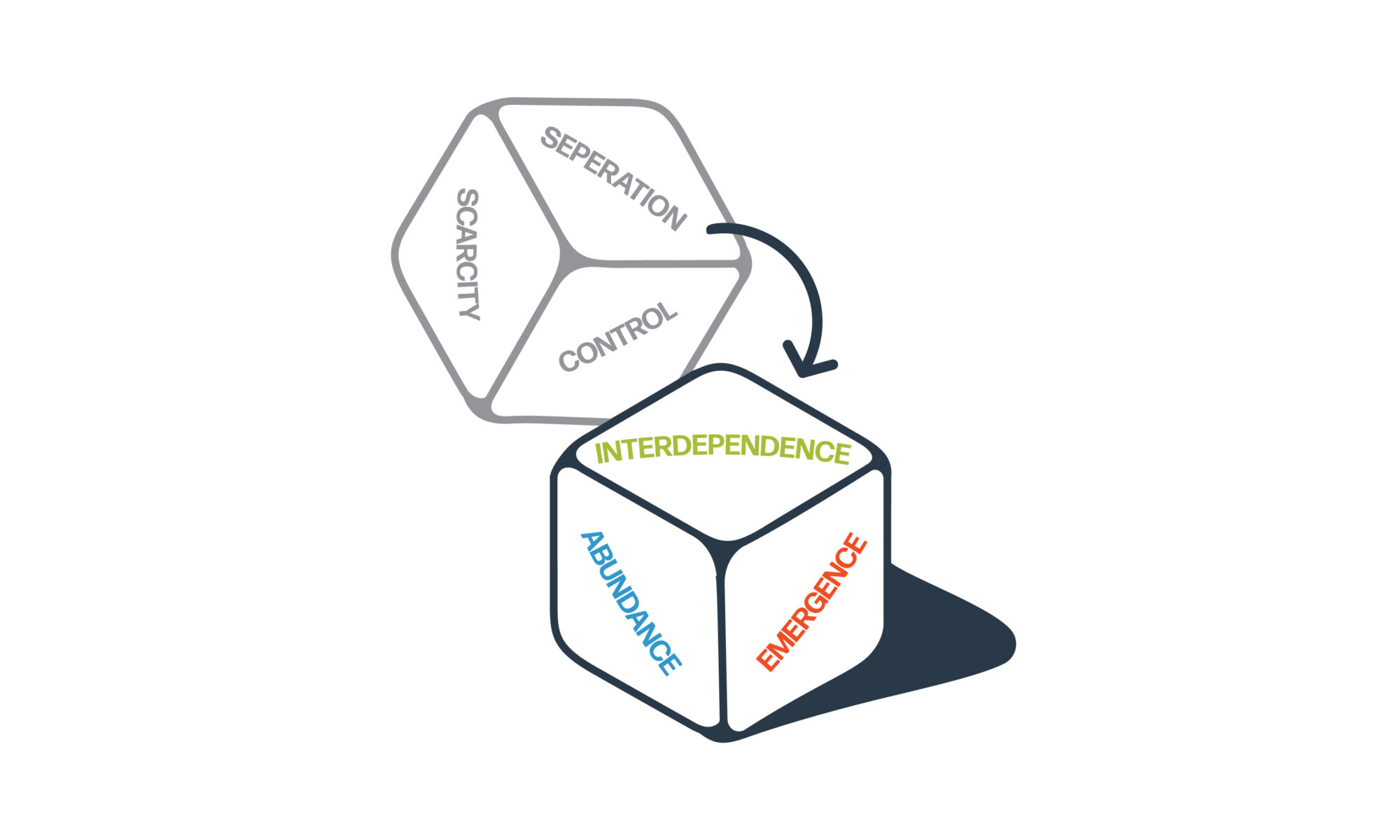
In the Pattern Book we sweep together terms like values, beliefs and ethics and gather them under the broad term ‘mindsets’.
Use this graphic — Downloadable, usable, shareable under CC BY-SA 4.0
Mindsets have high leverage in the system (see the System Bookcase). They shape operating systems and design decisions. They also take a long time to change. Working at the level of mindsets therefore has great potential but should also be approached with patience.
In The Regenerative Structural Engineer, we suggest that shifting to regenerative practice requires a shift in mindsets from three that are commonly held in our current economy to three associated with a more holistic world view.
- From separation to interdependence
- From scarcity to abundance
- From control to emergence
These mindset shifts are characterised in the table below.
From Separation to Interdependence
| Separate | Interdependent |
| I see myself as independent from the system I am working in | I see myself as dependent on the system I am working in |
| The health of the system has no impact on me | My health and the health of the system are inseparable |
| ‘I was stuck in traffic’ | ‘I was traffic’* |
From Scarcity to Abundance
| Scarcity | Abundance |
| There is no potential in the system | There is potential in the system |
| There isn’t enough for everyone | The system can meet everyone’s needs |
| I must protect my surplus to protect my future needs | If I give away my surplus I will end up with what I need |
| If I look after myself, I’ll be fine | If I look after the system, I’ll be fine |
From Control to Emergence
| Control | Emergence |
| I know the best options | The best options may not be clear to me |
| The best options will come from thinking about the problem in isolation | The best options will emerge |
| I need to control the system to limit my risk | I put my trust in the system to help me limit my risk |
| I need to plan every step | I just need to plan the next step and then see what to do next |
Delving further into mindset shifts
To explore each of these mindsets separately, jump into the following motifs in the Pattern Book.
- Interdependence — see In or Out, Stuck in Traffic and Living World.
- Abundance — see Harvesting Abundance, Desertification and Seeing the Potential.
- Emergence — see Standardising Decision-Making in Design, Seedling Analogy, Catalytic Style, and Beavers.
Role in the Pattern Book
Changing mindsets is one the most commonly used motifs in the Pattern Book because it serves so many functions — both as an early tool for engagement and for supporting on-going reflection:
- an early entry point to surface existing mental models
- a philosophical grounding for the more structural systems-based motifs
- an empathetic framing for working with resistant audiences see also Three Horizons > Understanding Group Dynamics
- a persuasion tool — helping audiences to notice their own perspectives and to experiment with seeing the world from an alternative’s
- a framing tool — for long-term business plans, infrastructure strategy or policy
- inspiration — challenging assumptions and sparking new ideas
- a way to interrogate values in decision-making
- prompts for personal reflection
User guide
Exploring your own mindsets
- Where do you personally identify as sitting on each of these three mindset spectra?
- In a work or project context, where do you sit? Is it different from where you personally identify?
- What other mindsets or values influence your decision-making?
Look for the mindset in the system
- Take a design decision, strategy or policy. Ask, what mindset shaped it?
- Then ask what it would look like if it were shaped by a different mindset?
- If you have populated a Systems Bookcase as part of another exercise, ask what mindsets have shaped the books on the operating shelf?
Exploring values in decision-making
- What values do I bring to decision-making?
- What values do others I consult bring to decision-making?
- What values are embedded in the tools and processes we use?
Using Changing Mindsets in different contexts
In the Pattern Book for Regenerative Design, the Changing Mindsets is a key motif in the following scenarios:
- Intuitive exploration of regenerative design — to explore how different mindsets affect what we observe about a situation and its potential.
- Systemic exploration of regenerative design — to investigate how mindsets influence how a system behaves.
- Critical thinking — as a tool for exploring how values influence decision-making.
- Personal regenerative practice — for exploring how different situations affect your mindset. What mindsets do you identify? What do you notice?
- In continuous place-based design — the mindsets challenge the lenses through which we look at places, communities and organisations.
- With developers and asset managers — map your client’s regenerative mindsets, understand their risk profile and find the right entry point for discussion.
- Transforming supply chains — investigate our relationship to materials, considering separation from source, hoarding of scarcity and top-down control of material use.
- Shifting business strategy — explore what mindsets influenced the shaping of the current strategy and how shifting these can change direction of travel.
- Cultural shift — what mindsets influenced the systems of control and organisational hierarchy in the system.
- Local and national-level policy and regulation — investigate the prevailing assumptions that have shaped existing policies, and how scarcity, risk and control have shaped what goes on the Systems Bookcase.
Related motifs
Abundance, Action Learning, Beavers, Culture Web, Desertification, Emergence, Framing the Question, Harvesting Abundance, In or Out, Interdependence, Levels of Regenerative Intervention, Living World, Persuasion, Seedling Analogy, Seeing the Potential, Standardising Decision-Making in Design, Stuck in Traffic, Wildwork.
Footnotes
*The traffic metaphor comes from Wahl, D. C. (2016). Designing Regenerative Cultures. Triarchy Press.
Recommended courses
-

Seeing the System — a systems led intro to regenerative design
Price range: £225.00 through £425.00 -
Regenerative Design Lab — Cohort 6
Price range: £950.00 through £2,800.00
Related posts from For Engineers (and other Humans)
-
Spotting people spotting kingfishers
My workshop today is in an office along the same river catchment as the one I live on, so my commute takes me deep into the Frome valley. I know kingfishers nest here but I almost never spot them. Luckily, I’ve found a hack. Look for someone with a massive telephoto lens. Stand nearby. Follow…
-
Is infrastructure alive? — Three mindsets shifts for regenerative infrastructure design
One of my favourite books of 2025 was Robert MacFarlane’s Is a River Alive? and it has been at the forefront of my mind as I try to do the mental work of climbing out of my conventional thinking to imagine what regenerative infrastructure might mean. Ultimately, it comes down to mindset. Before we get…
-
How do you write a contract based on regenerative values?
Today I’ve been thinking about that question as we finalise the participant agreement for the Regenerative Design Lab. People are about to hand over their money, and that deserves clarity. But it also raised a deeper question: what would a contract look like if it genuinely reflected the regenerative values we teach — interdependence, emergence…
-
Signs of local weather
I’m enjoying being absorbed by The Secret World of Weather, by Tristan Gooley. It reveals to the reader secret signs all around us about how the weather is likely to behave. Signs that hide in plain sight, that we have forgotten to notice. The repeating theme in the early chapters: modern forecasting models deal with…
-
Attempts to give up sarcasm
A few years ago I made a New Year’s resolution to stop being sarcastic. Some of my favourite comedians use sarcasm. Pointing to what something is by saying the opposite is both a powerful send up and also a great way of directly saying difficult things. But here you get on to a slippery slope,…
-
Never mind the aurochs
…here’s the Tauros. I read last week that Aurochs were the third heaviest mammals to wander Europe, after woolly mammoths and their sartorial companions, woolly rhinoceroses. Aurochs were like giant long-horned cows. They crashed their way through woodlands, opening up the canopy by knocking over trees. In doing so they allowed an interconnected mosaic of…