On scale, specialisation and life beyond pins

One of the commonly-cited benefits of scaling-up an operation is to enable individuals to specialise

Adam Smith famously argued that a pin factory, where each worker focused on specific step of the pin-manufacturing process, far more pins could be made than if each worker made whole pins on their own. 

This example has become one of the key doctrines of classical economics. But I find the example disingenuous. 

Firstly, because it is not like before Adam Smith came along there were halls full of pin makers unproductively making pins on their own. More likely, there were people who could make pins — and they could also make a host of other ironmongery — because they skilled in metalwork and a broad range of related skills. 

Life doesn’t just need pins. 

Second, his pin factory only works under a specific set of conditions. 

To make the most of each specialised worker, there must be no bottlenecks from one step to the next. Workers must work in shifts to maintain flow. There can be no variation in output. Input materials must be reliably supplied. Environmental conditions must be tightly controlled. And there must be a constant supply of customers, all buying pins.

But meeting all of these requirements, this now large-scale enterprise starts to exert a gravitational pull of its own. It shapes when, how and for how long people work. Like a giant magnet, supplies of iron are sucked into it. And it shapes what people consume — more pins. 

Scaling up does enable specialisation. And specialisation can increase productivity. But we mustn’t leave the wider costs of specialisation out of the denominator on the productivity equation. 

The regenerative designer asks, not how can I scale up, but how can I find the scale of operation that enables the most parts of the system to benefit?

The maths of too many meetings

Do you ever feel that all you do is sit in coordination meetings?

If two people work together, then there is one relationship to manage.

By manage, I mean checking in with each other, setting goals, coordinating activity, giving feedback etc.

If three people work together, there’s three individual relationships to manage.

If four people work together, there’s six relationships.

If ten people work together, there’s 45 relationships to manage.

You get the picture. The number of relationships in a group of people quickly blows up as the group size grows.

For a group of n people, the number of individual relationships is n(n-1)/2. In other words, it’s a squared relationship.

And if the number of relationships goes up, so does the number of coordination meetings.

Of course, the reason for growing the number of people in the team is usually to gain productivity. But the gain in productivity has to outweigh the admin burden of coordination.

Doubling the team size means quadrupling the amount of coordination. But does doubling team size really increase output by a factor of 4? If the admin overhead is going up quicker than the output, then productivity is going down.

It’s no wonder that people complain that they are in back-to-back meetings and can’t get any work done.

Perhaps the system has got too large — the means no-longer justify the ends.

Ultra-processed information

It’s super quick to absorb. 

Cheaply available. 

It bares little resemblance to its source. 

Its ingredients can come from anywhere. 

The growers are anonymous. 

Put together using processes you don’t understand.

It is optimised for what you crave rather than what you need.

And like other ultra-processed things:

It doesn’t quench your hunger.

It’s addictive. 

Easy to binge on.

But can be strangely unsatisfying. 

But we don’t just think with our heads — we think with our whole bodies. 

We process information by moving through the world, interacting with the environment, relating to other people, remembering through different neural centres in the body. Thinking has physical and emotional dimensions alongside the cognitive that are part of how we have evolved to make sense of the world.

When we are more active seekers of information rather than passive consumers:

  • We have to seek out what we need, creating relationships with sources, with people, with places. 
  • The process takes time, which gives us time to think.
  • We give the opportunity for our full range of bodily thinking circuits to participate. 
  • The inputs require chewing on, and this gives us time to discern what need.

The process is slower but the outcome is more nourishing.

Non-fungible Tree

This dying tree is outside London Euston station. It desperately needs water.

It sits next to the stump of the enormous London Plain that was recently felled to make way for the construction of the new station.

It symbolises so much about the relationship between construction and the living world. 

How efficient we can be at destroying life. And incompetent at creating it. 

Just-in-its-own-time delivery

We’ve become used to just-in-time delivery. The antithesis of stockpiled inventory. 

But when the living world delivers its abundance, it happens all at once. Anyone engaged in community fruit growing in the south of England will know that this season, it has all come at once. 

This is inconvenient — but living systems don’t exist for our convenience. Rather we have the chance to benefit from their surplus. 

Forcing a cyclical system to produce a continuous output diminishes it, reduces quality and stresses the system. The healthier option for the ecosystem is for us to work with abundance when it arrives. 

This applies whether we are gathering fruit or harvesting materials from buildings that awaiting demolition. 

When it comes, we need to drop everything to harvest, distribute and prepare for storage until it is needed in the leaner months.

What do they grow?

I recently revisited a childhood film favourite, The Young Einstein. It begins on a cider farm in Tasmania. One evening, our hero tells his parents, 

“I want to be a physicist.”

Dad responds, “That’s great son. What do they grow?”

It’s hard to win at poker by playing chess

Complicated systems are like chess: we know the rules, and with some calculation, we can work out the best possible move.

Complex systems are like poker: we know the rules but there is much more to how the game will unfold: the relationships, how people have played, patterns emerging.

Chess and poker require different strategies.

Engineers are often trained to solve complicated problems. We calculate outcomes, we stipulate procedures, we aim to control.

But the systems we are engaging with are often complex. Complexity requires different approaches: cycles of observation, action, reflection and updating plans.

And yet, it often feels like we use complicated strategies for complex systems.

It’s hard to win at poker by playing chess.

This distinction between complicated and complex systems draws on the work of David Snowden and the Cynefin Framework

For more on this topic, see the entry for Complexity in the Pattern Book for Regenerative Design.

Canvas and Twill — the patterns for two new short courses in regenerative design

More and more design teams are committing to regenerative principles and goals in their projects. This is very promising. But it also raises the question, how do upskill a team in a way that is both quick and meaningful?

The Pattern Book gives us two starting points:

  • Pattern 01: Canvas — for teams who want to start with observing real systems and move to theory.
  • Pattern 02: Twill — for teams who want to start with theory and move to observation of real systems.

I’ve used these two patterns to create two new short online courses.

Feeling the Future, and

Seeing the System.

Both are designed as a rapid introduction to regenerative design. They don’t do the deep work (you have to do that). But they will give you a strong foundation to build from, ground in the frameworks we use in the Regenerative Design Lab.

Pick the course that suits your learning style. And please tell your friends and colleagues. Thanks!

Field notes: the Kalideascope meets the Ambition Loop

This week I was invited to run an afternoon session for the Engineers Without Borders UK Systems Change Lab at their event in Glasgow. This event is part of their wider programme to create system change in engineering education to build globally responsible engineering. 

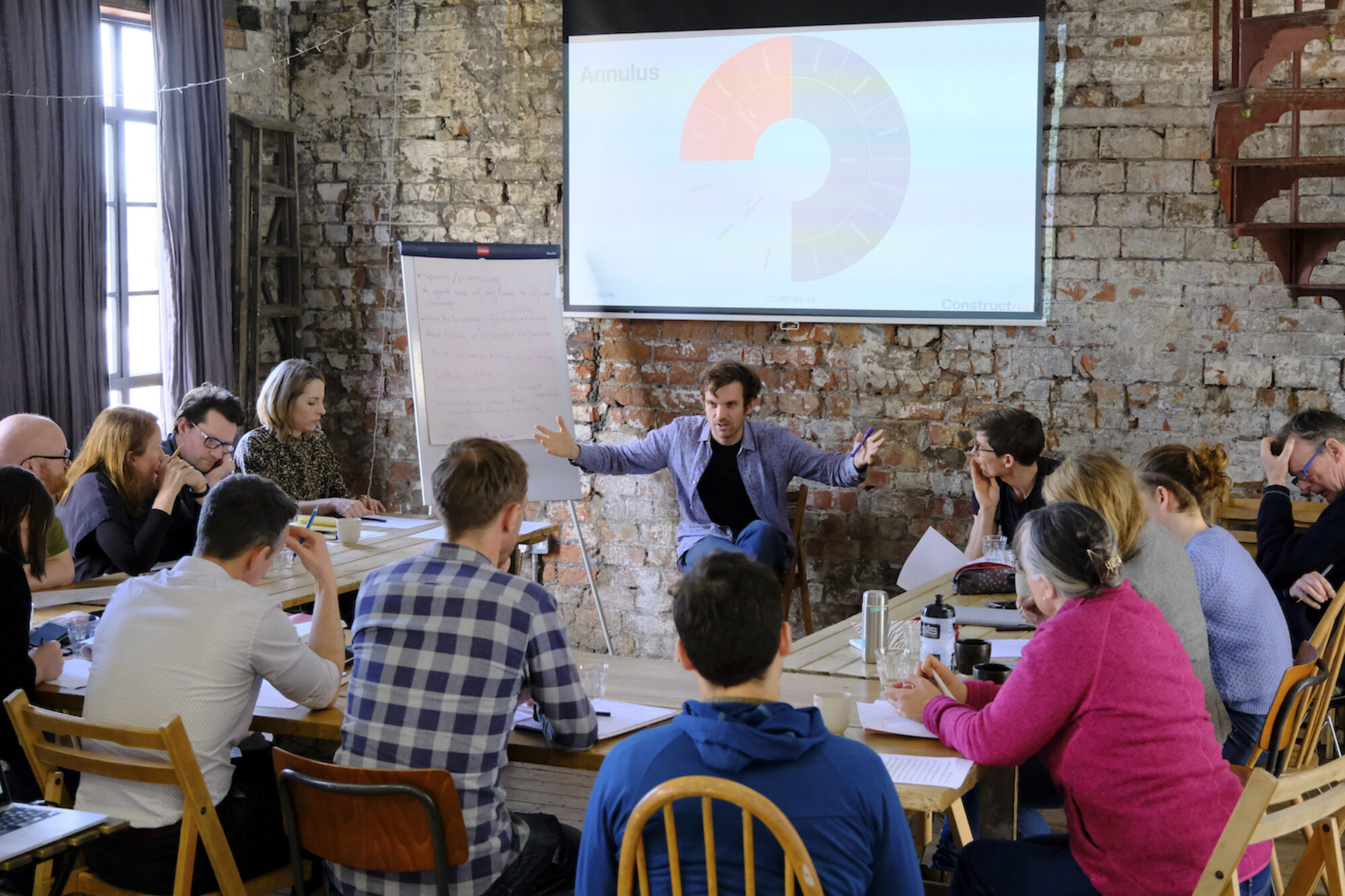
My brief was to prompt some creative thinking as part of the ‘develop’ phase in their programme. The session was an opportunity to pair two tools that I have previously used separately in our facilitation at Constructivist: the Kalideascope and the Ambition Loop. 

For years I’ve been developing and refining the Kalideascope as a structured model for divergent thinking. It helps users move beyond one initial idea by gathering a wide range of inputs, capturing questions and creating the conditions for new connections to emerge. 

While the Kalideascope generates lots of ideas, we need a different tool for the convergent thinking that enables us to choose between ideas and improve on them. So here I brought in the Ambition Loop — a tool that Bill Sharpe introduced us to in the Regenerative Design Lab to help identify what ideas have the potential to create systems change. The Ambition Loop model helps us by going beyond testing our ideas against the brief to testing how ideas can be taken up by and amplified within a systems. 

This pairing of the Kalideascope with the Ambition Loop created a strong arc for the session. The first tool expands the fields of possibilities. The second homes in on the ideas that the system might take up. 

I am seeing that with the Ambition Loop model that it tends to draw out questions about who we need to partner with to make change. 

If you have a copy of the Pattern Book for Regenerative Design, I suggest, like me, you annotate the end of the Kalideascope entry to say that it works well paired with the Ambition Loop motif as a divergent-convergent pair.