
A three-part framework for designing with the same principles that enable living systems to thrive.
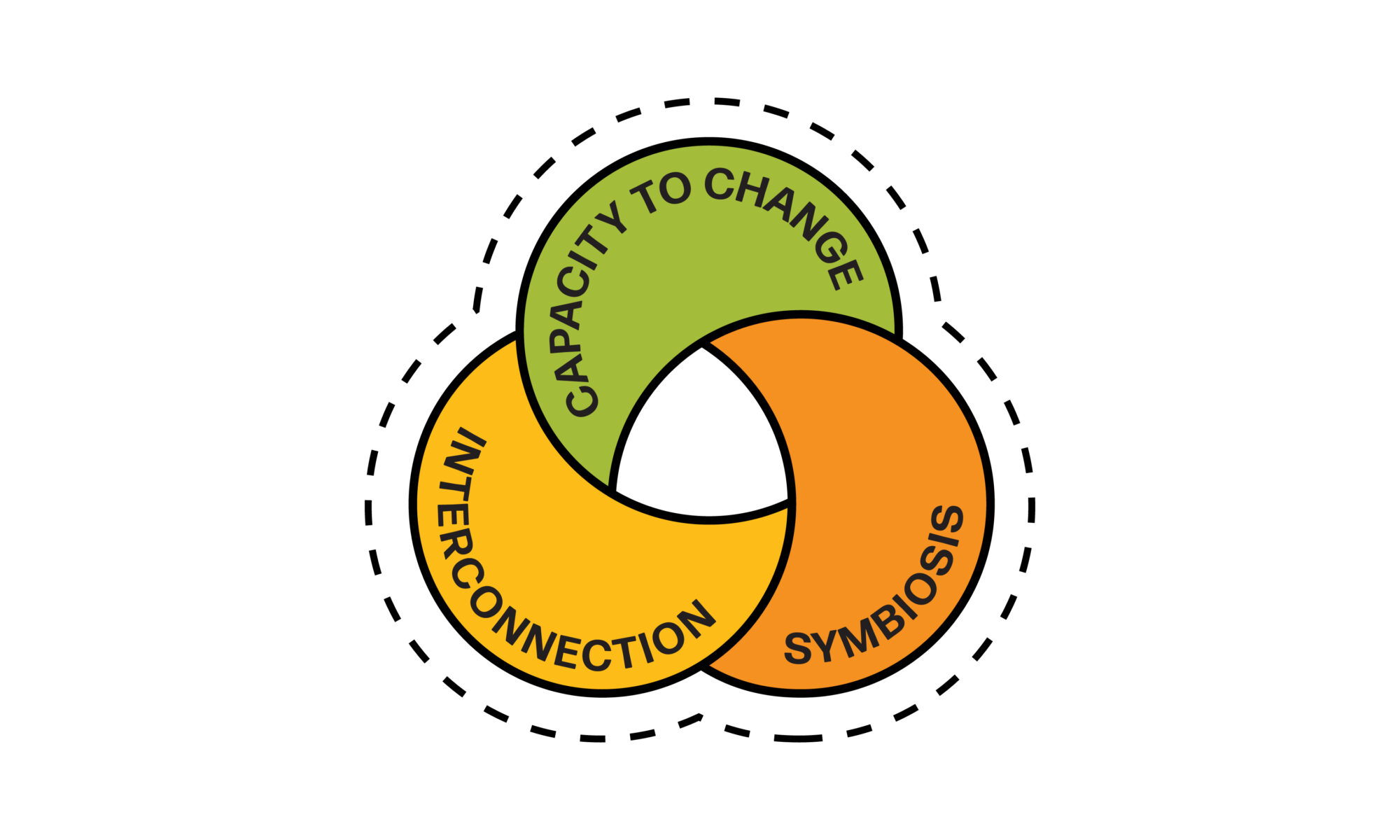
The Living Systems Blueprint is an anchoring motif in the Pattern Book for Regenerative Design, providing a systems-level explanation of how living systems thrive and how humans can apply these principles in design. It serves as a key bridge between understanding systems and designing interventions.
Use this graphic — Downloadable, usable, shareable under CC BY-SA 4.0
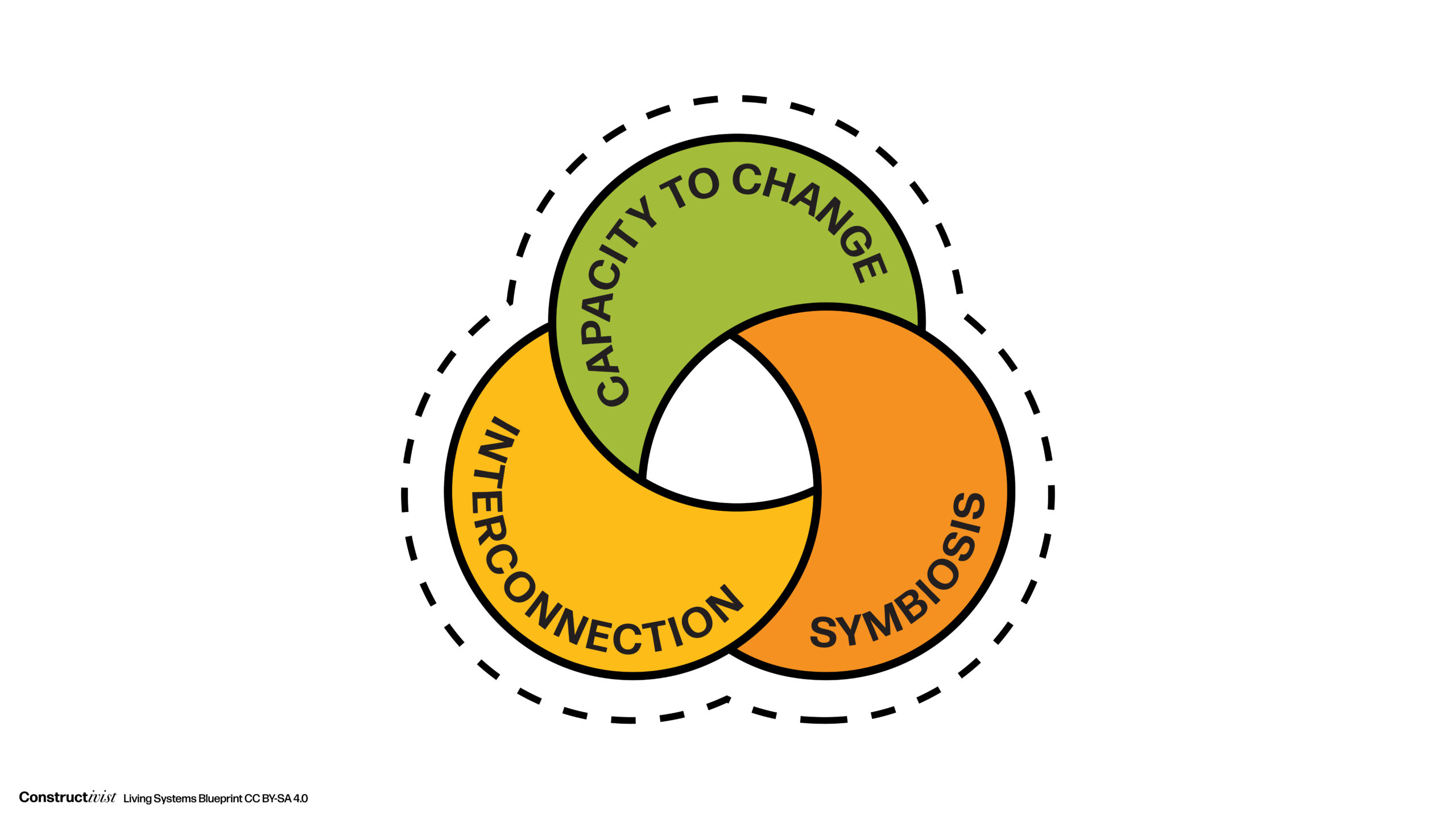
The Blueprint describes three characteristics of thriving, living systems:
- Interconnection — which create multiple levels of feedback loops that keep the system in balance.
- Symbiosis — circulating flows of resources within the system that increase richness within ecosystem limits.
- Capacity to change — the system’s ability to evolve and adapt to changing conditions.
These characteristics provide a blueprint for designing systems that have the capacity to survive, thrive and co-evolve, drawing on the best example we have of how to do this — the living world itself (Broadbent & Norman, 2024).
Each of these characteristics is explored separately in the Pattern Book. Here we look at how to work with the Living Systems Blueprint as a whole.
From the Pattern Book for Regenerative Design.
Role in the Pattern Book
This motif frames conversations about thriving at an operational systems level. It helps:
- Translate theory into action — turning the high-level goal of regenerative design and the mind set shifts it requires into practical applications.
- Design for thriving — see the Brief for Thriving.
- Shift focus — from thinking about projects to systems in business strategy, policy and infrastructure design.
- Establish tests — to assess the regenerative character of our projects and proposals.
Paired with regenerative-ambivalent motifs (such as the Systems Bookcase), this motif clarifies what ‘thriving’ looks like.
User guide
The Living Systems Blueprint is not a good starting point. Most people don’t see the world in systems. It is a motif that works best as an answer to a question, for example:
- How can supply chains contribute to rather than deplete biodiversity?
- How can humans work in harmony with living systems?
- How regenerative is my project?
Here are three ways to apply it.
1 — Work with a case study
Choose a project that you think demonstrates regenerative qualities. Explore how it:
- Builds interconnection between people and place.
- Turns waste streams into inputs.
- Builds local capacity to maintain and update buildings and infrastructure.
2 — Map a system
Draw the system you are working in and explore:
- Where are the connections in the system strong, weak or missing?
- How do these enable feedback loops and where do they fail to form?
- Which waste streams flow out of the system and which ones become useful inputs?
- Is this system rigid or able to adapt?
3 — Go for a walk
Use the following observational motifs to see the characteristic of the Living System Blueprint in action (or missing) in the real world:
- Wildwork — compares human and living systems.
- Systems Survey — take systems thinking for a walk.
- Psychoderive — seeing urban space from a new perspective.
Conclusion
The Living Systems Blueprint offers a practical way to understand systems that support thriving. By bringing together three characteristics of living systems — interconnection, symbiosis and capacity to change — it offers us a template for designing human systems that align with the rest of the living world.
This motif is a bridge between concepts, helping to translate the high-level goal of regenerative design into projects, strategies and policies.
Related posts from For Engineers (and other Humans)
-
Outvestment versus investment
I was asked, Is regenerative design anti-investment? No, but it does depend on the kind of investment. In regenerative design we use living systems as a guide for how to create an economy that can thrive within ecological limits. Living systems create richness through the circulation of energy and materials within ecosystems. Over time, ecosystems…
-
Newnham College Boathouse
Featured on the cover of this month’s Structural Engineer magazine is the new boathouse for Newnham College in Cambridge. The boathouse is a small timber structure designed to house rowing boats. Faced with conflicting constraints — a short-term lease, high design expectations and nearby tree roots — the team moved away from a more conventional…
-
Into interconnection
This week at the Regenerative Design Lab, we’ve been working with the Living Systems Blueprint — a model for connecting high-level regenerative thinking with more tangible design decisions. The Blueprint identifies three qualities common to living systems. One of these is interconnection. Thriving living systems tend to have high levels of local connectivity: contact between…
-
Recipe for parasitic extraction
Borrow some money. Use it buy an asset — say, a water supply company.Load the debt onto the company.Continue to extract profit. Last week I went to a talk where Hettie O’Brien presented her book The Asset Class. This, in essence, is the mechanism she describes — used by private equity across sectors, from water…
-
Building repair infrastructure
Here are my working thoughts on United Repair Centre, one of the organisations I met at the Future Observatory event The New London Commons: Circular Hubs for Fashion and Construction. This organisation does not just do repair. They are building the infrastructure that makes repair possible — at scale — in the fashion industry. A…
-
Fuelling the Regenerative Design Lab
This March we are holding the Spring Residential workshops for Cohort 6 and Cohort 7 of the Regenerative Design Lab. Appropriately I was down at Hazel Hill Wood this weekend for the wood’s Wood Chop Challenge — the annual event that provides firewood for that heats the retreat buildings used by many groups who come…