
Giving attention to the future

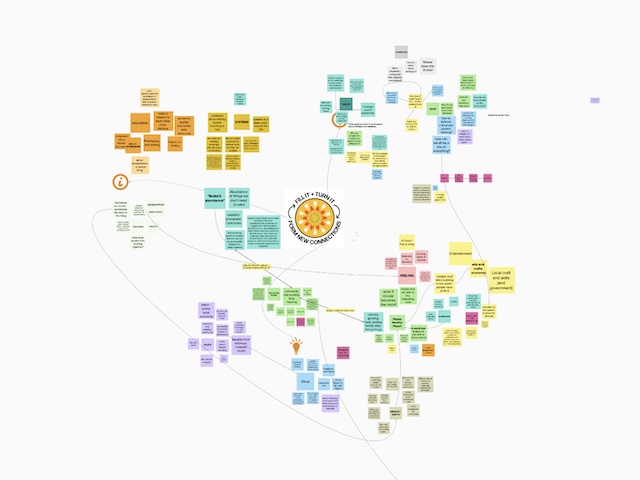
Screen shot showing post it notes arranged to look like a kaleidoscope

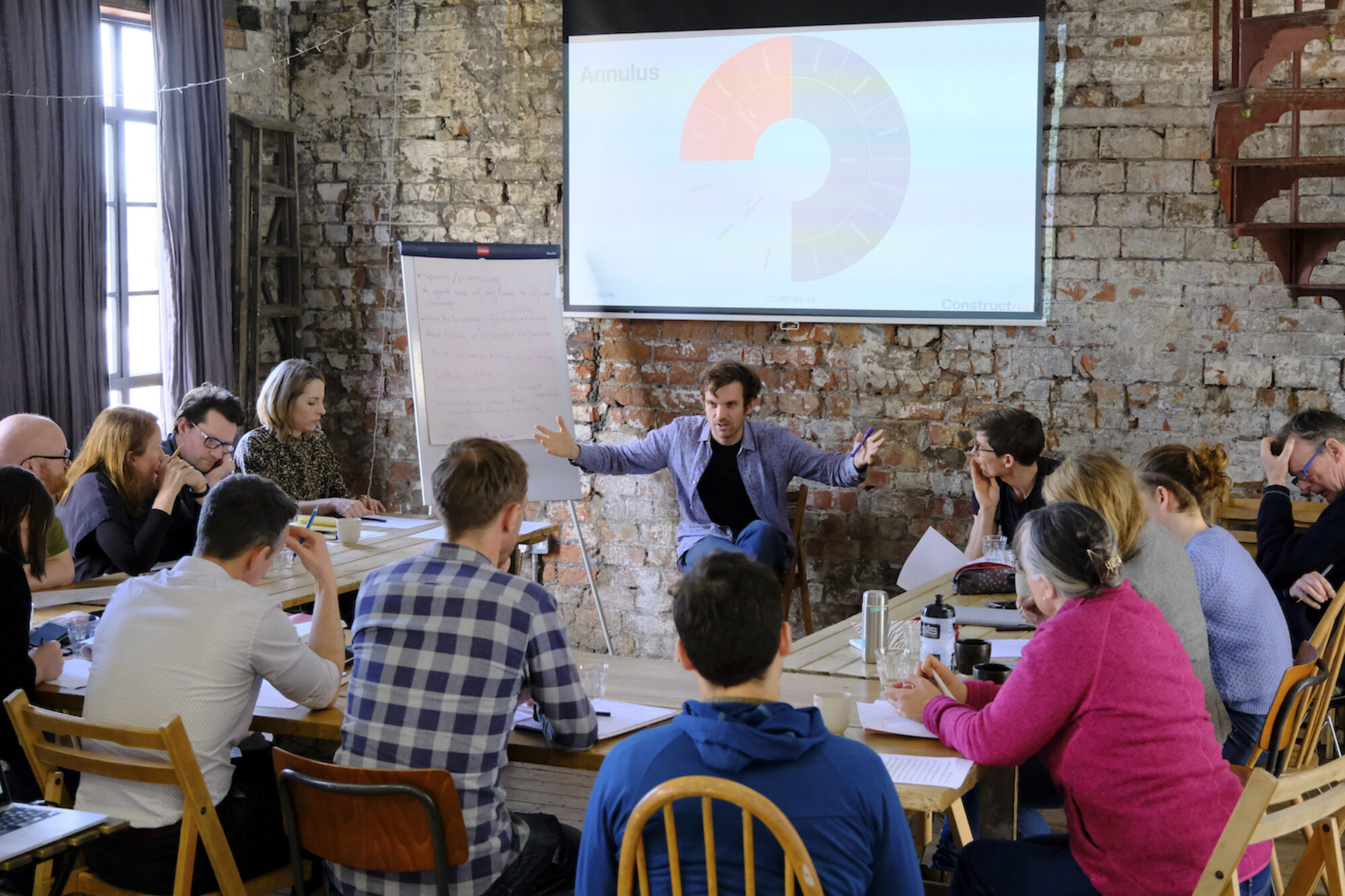
This month at the Regenerative Design Lab, Cohorts 6 and 7 both spent time on line imagining the future.

Using the Three Horizons model, we explored Horizon Three, not as a prediction tool but rather as a canvas for finding shared hopes for the future.

We structured the conversation using a Kalideascope — a tool central to our design teaching at Constructivist. And this makes sense because as designers we are constantly imaging the future. What changes here is that the principal ingredient to the process is our hopes for the future. 

A pattern I am spotting is how much common ground emerges in these sessions. Themes of connection, community, stewardship, making and different ways to find meaning emerged. And along side these, lots of examples of different ways that these futures exist in the present, there to be cultivated, encouraged, supported, connected up.

I think most valuable is that people didn’t leave with a single vision of the future but a long list of ideas for experiments, practices and actions. 

Over the coming months, the Lab will move into the next phase of the journey: designing experiment sand looking for ways to create transitions to that more hopeful future.

The dream walk experiment at Hazel Hill Wood

Last week at Hazel Hill Wood we ran a ‘dream walk’ with staff and trustees. The aim was to tune into our long-term hopes and aspirations for the site, as we continue the responsibility of creating a thriving place for care and learning.

Hopes and dreams are part of what a place is trying to do. They arise from our relationships with place and help steer the flow of change.

We began with Zuma Puma’s Box-Clearing warm-up (a technique I learnt from one of my clown teachers —more on that in another post), then set out into the woods. The rules were simple:

  • Walk to a place in the wood.
  • Walk with your gaze slightly raised to invite in fun and curiosity (another technique from another clown teacher, Robyn Hambrook) 
  • Share what you’ve always hoped for this place.
  • Imagine how it could be, how it might change.
  • Speak until you’re done.
  • The next person picks up — not to challenge, but to add their own dreams.

We captured dreams in audio and notes, later mapped across the site.

What I learnt from facilitating the process

  • The temptation to say why not is strong — the delivery mindset of Horizon One is never far away. With reminders, we shifted into a more open Horizon Three frame.
  • Some dreams resonated and compounded — one voice building on the next until a vision took shape.
  • Some spots felt dream-silent, as if they were low-energy places. Others flowed with possibility, hinting at where change energy gathers. This was a real ah-ha moment for me.

This dream walk supported three things at once: observation in Continuous Place-Based Design, imagining Horizon Three in the Three Horizons model, and adding inputs to our Kalideascope

You could consider carrying out a dream walk where you are: walk, notice, and speak your dreams of place aloud. You might be surprised by what takes shape.