
Regenerative Design Lab reading list updated

As we prepare to receive Cohorts 6&7 into the Lab next week, I have been revisiting and updating our reading list

This year I’ve added four books: 

Some of these I read a while ago, one I am still reading, but I’m including them to make explicit something that has been strengthening in the Lab: the role of play, attention and emergence. 

Not just in how we facilitate. But in how we design. And how we show up.

Regenerative design isn’t just about feedback loops and systems levers. It is also about attention, tuning in, humility and sensing the audience — whether that’s a client, a colleague, a community or an ecosystem. 

Of all the established books on the reading list, one remains an old friend: the Dictionary of Lean Logic

It is a whole world imagined of living within ecological limits. It is where I return to for grounding and new challenge.

Updating the list each year feels like a good spring ritual. 

Regenerative practice is a vast field and this list represents just my intellectual journey, and not the whole cannon. I’d love to carry on widening this list, and I  welcome recommendations… but as I am very slow reader (it only seems to go in if I write things down)… it may take me a while to get to them. 
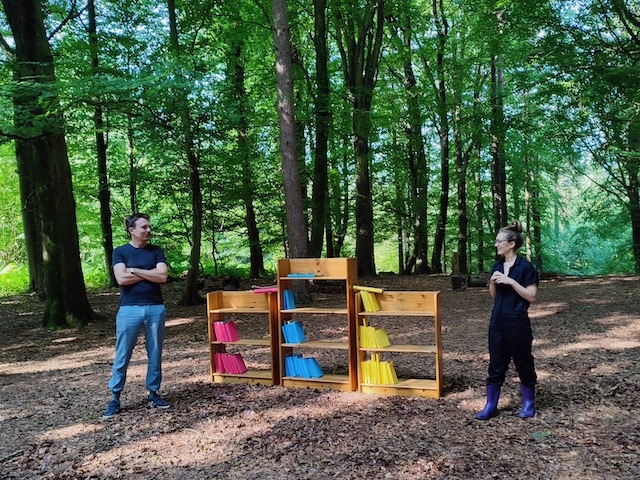
You can read the list here.

When a group of learners becomes a living system

All week we’ve been interviewing candidates for Cohort 6 of the Regenerative Design Lab. With such a strong range of applicants, it’s been a real privilege to spend time with so many thoughtful, committed humans.

And it’s not just us asking the questions.

Candidates ask us questions too, as they decide whether they want to commit to this journey. One question, in particular, keeps coming up, what does a good outcome for a cohort look like?

Over the week, my answer has been converging on a clear image.

The Lab is a facilitated, carefully scaffolded process. We design the conditions, hold the space, and guide the learning. But that’s not the end goal.

Over time, something else begins to happen.

Cohorts start to form their own connections.
People rely on one another, not just on the facilitators.
Support, challenge and learning begin to circulate within the group.

The process starts to become mutual.

Participants bring energy, insight and care — and receive it in return. The cohort starts to function less like a programme and more like a living system, sustained by the quality of its relationships.

As confidence grows, the group becomes more able to respond to what emerges. New questions surface. Directions shift. The cohort adapts — not because it was pre-designed to do so, but because the conditions allow it.

Our hope is that, over time, a cohort develops enough of its own energy to sustain itself. That it unlocks the abundance already present in the group, rather than relying on continued external input.

When that happens, the role of facilitation begins to fall away.

The cohort can fly on its own.

Not dependent on us.
Not dependent on funding.
Sustained by what participants create, share and renew together.

Interconnection.
Symbiosis.
Capacity to adapt.

A system that draws on renewing, abundant resources rather than depletion — and continues because it wants to, not because it is being held in place.

For me, that is a deeply regenerative outcome.

Big news — Cohort 6 Applications for the Regenerative Design Lab are now open

Our big news this week is that the application process is now open for Cohort 6 of the Regenerative Design Lab. 

Here’s some things that make this moment particularly significant

This is an open lab — unlike the previous two labs where we had focused more explicitly on policy, this lab is for people interested in applying regenerative thinking across a wide range of contexts. We haven’t had an open lab like this for two years, so we are expecting a large number of applicants. 

Policy makers are still very welcome, and you’ll be working alongside designers and built-environment professionals to explore regenerative thinking in practice.

With this lab, our community of past and present participants will exceed 100. The network effect of this many activated change-makers is potentially huge.

The fly-wheel is spinning — with each revolution of the lab, we add more momentum: insights, tools, learning from taking action. It gives each cohort the potential to go further. 

We have a text book — the Pattern Book for Regenerative Design is our manual for developing regenerative conservations with a wide range of audiences.

So are you ready to apply to join this journey? If so, we’d love to receive your application.