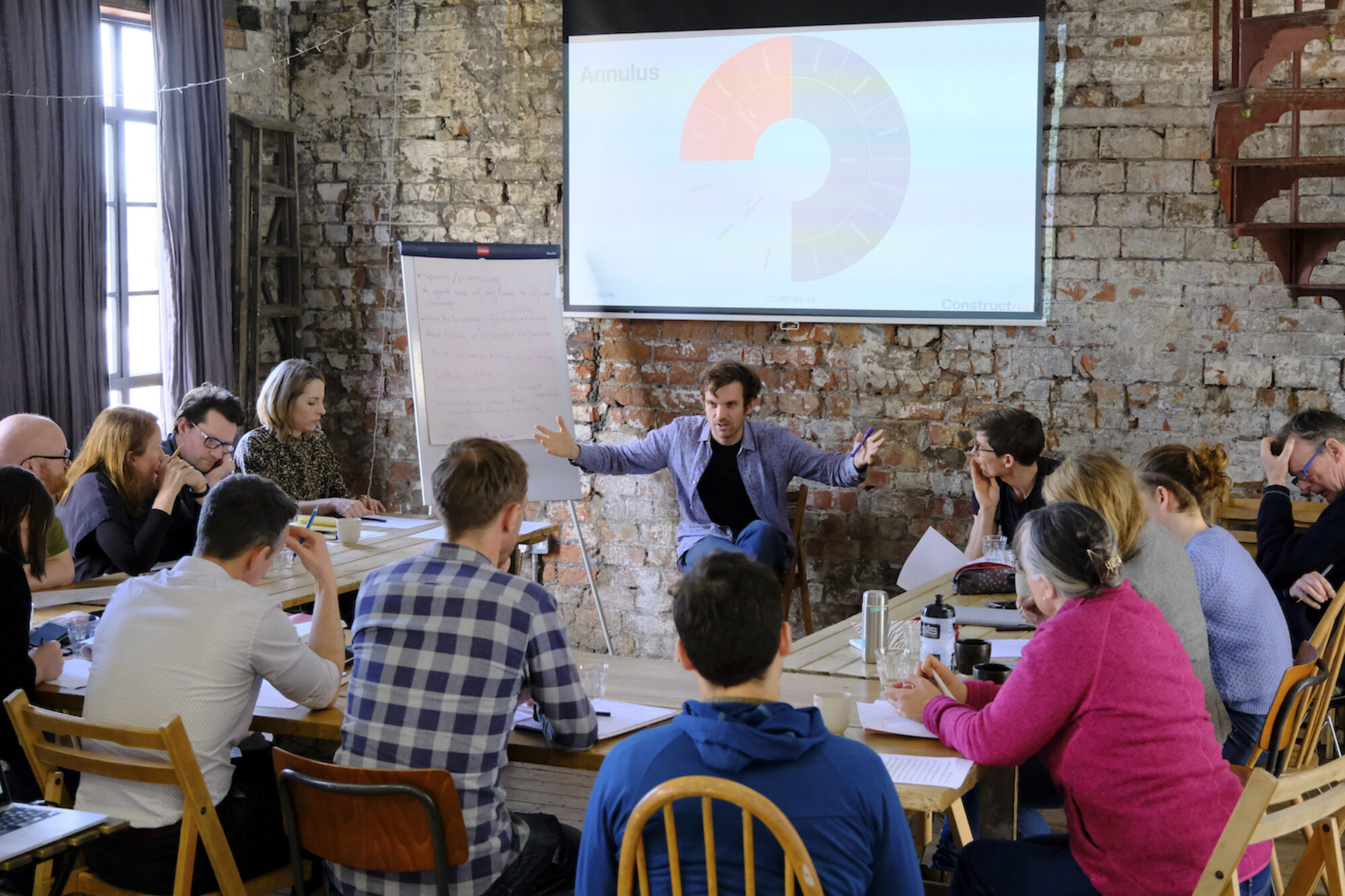

Easier to talk about what we don’t want than what we do

This riff is a partner to my one this week on humour and sarcasm. If you’ve read that one you’ll spot the connection. 

I’ve noticed recently that workshop groups tend to find it much easier to talk about their shared pain than their shared hopes. I think this is almost certainly cultural. 

Culture is reinforced by rituals and routines. In the UK, we almost ritualistically complain about weather and transport. Another is control systems. 

Culture is also reinforced through control systems — and social media is one. It is no coincidence that social media algorithms long ago started prioritising negative stories over good — we love them.

There is a method of physical theatre training called via negativa, meaning the negative road. It is a method of teaching that doesn’t tell you how to be funny, but it tells you when you are not funny. The idea is that the teacher keeps telling you something is bad until you find something is good. Handled with sensitivity and care for the student it is a powerful teaching technique. It works because the student has to keep proposing ideas and in that process, discovers something that is uniquely theirs. 

But it requires a lot of the student — they’ve got to have the motivation to keep coming up with something new.

I think we can see a negative culture as a collective via negativa

Always finding the flaw, what’s going wrong. If an individual has the motivation to keep on showing up, they can overcome it, but that is a lot of effort. 

An alternative, more generous and easier to deploy method is to be encouraging, and inviting people to give something a try. 

Creative psychologist Mihaly Csikszentmihalyi proposed that one the best ways to work on building a creative culture in an organisation is not to work on individual creativity, but rather on our culture of listening and encouraging. 

We can seed this culture by shifting the rituals and routines — asking what went right before asking what went wrong. And by shifting the control system — shifting away from doom-scrolling towards practices that tune is into what is possible.

Then we might find that our culture tilts in the direction of what is possible, of what we want to build together, rather than what we don’t.

Attempts to give up sarcasm

A few years ago I made a New Year’s resolution to stop being sarcastic. 

Some of my favourite comedians use sarcasm. Pointing to what something is by saying the opposite is both a powerful send up and also a great way of directly saying difficult things. But here you get on to a slippery slope, because by not saying what we mean, we enter into a sort of passive aggression, if it’s something we don’t like. And if it’s something we do like, it’s a sort of passive passion. 

Over time, what bleeds out it is sincerity. And then we are on a slippery slope to hopelessness and cynicism. 

I once learnt from clown teacher Frankie Anderson about different levels of humour. One that lies in pain and misfortune — Schadenfreude. And then there is one that lies in disdain — irony, aloofness and sarcasm. This is the humour I had grown up with but found myself leaning on too much. 

But there is a third level that lies in shared connection — the shared human experience, empathy, joy, the absurd, the possible. And it feels like we need more of the possible. What could be. What we hope for. However ridiculous that is. Because that is a much more compelling reason for action than cynicism. 

When I told people around me I was trying to stop being sarcastic, interesting things started happening.People were pleasantly surprised when they knew I was being direct. I found conversations more joyful. And, in case you were worried this all sounds rather sincere and po-faced, I found telling it straight is actually quite funny.

Applied in the hands of skilled comedian, sarcasm is great. But in every day life, I think it grinds us down.

But don’t take it from me. I invite you to give it a go. Try going a whole day not being sarcastic, and see what happens. I think it’ll be great. And you know I mean it.

Seeing the latent potential

As Rob Hopkins points out in his wonderful book From What Is to What If, the climate crisis is, at its core, a crisis of the imagination. If we can’t envision a thriving world, we won’t be able to create it.

A key skill in regenerative design is cultivating the conditions that allow us to imagine this thriving future.

This requires us to not only see what exists but also to imagine what could be. For example, looking at an empty park and envisioning it full of people running , or standing on a traffic-filled street and picturing it so quiet that birdsong fills the air and people stop to chat.

In these cases, the elements are already present—they are latent. But to unlock this latent potential, we must recognise both the desertified present and the abundant possibilities. Only then can we begin to design the next step toward that vision.

Equipping ourselves for this imaginative work is, I believe, a critical part of becoming a regenerative designer.

Hopkins, R., 2019. From What Is to What If: Unleashing the Power of Imagination to Create the Future We Want. Chelsea Green Publishing, White River Junction, VT.

The dream walk experiment at Hazel Hill Wood

Last week at Hazel Hill Wood we ran a ‘dream walk’ with staff and trustees. The aim was to tune into our long-term hopes and aspirations for the site, as we continue the responsibility of creating a thriving place for care and learning.

Hopes and dreams are part of what a place is trying to do. They arise from our relationships with place and help steer the flow of change.

We began with Zuma Puma’s Box-Clearing warm-up (a technique I learnt from one of my clown teachers —more on that in another post), then set out into the woods. The rules were simple:

  • Walk to a place in the wood.
  • Walk with your gaze slightly raised to invite in fun and curiosity (another technique from another clown teacher, Robyn Hambrook) 
  • Share what you’ve always hoped for this place.
  • Imagine how it could be, how it might change.
  • Speak until you’re done.
  • The next person picks up — not to challenge, but to add their own dreams.

We captured dreams in audio and notes, later mapped across the site.

What I learnt from facilitating the process

  • The temptation to say why not is strong — the delivery mindset of Horizon One is never far away. With reminders, we shifted into a more open Horizon Three frame.
  • Some dreams resonated and compounded — one voice building on the next until a vision took shape.
  • Some spots felt dream-silent, as if they were low-energy places. Others flowed with possibility, hinting at where change energy gathers. This was a real ah-ha moment for me.

This dream walk supported three things at once: observation in Continuous Place-Based Design, imagining Horizon Three in the Three Horizons model, and adding inputs to our Kalideascope

You could consider carrying out a dream walk where you are: walk, notice, and speak your dreams of place aloud. You might be surprised by what takes shape.