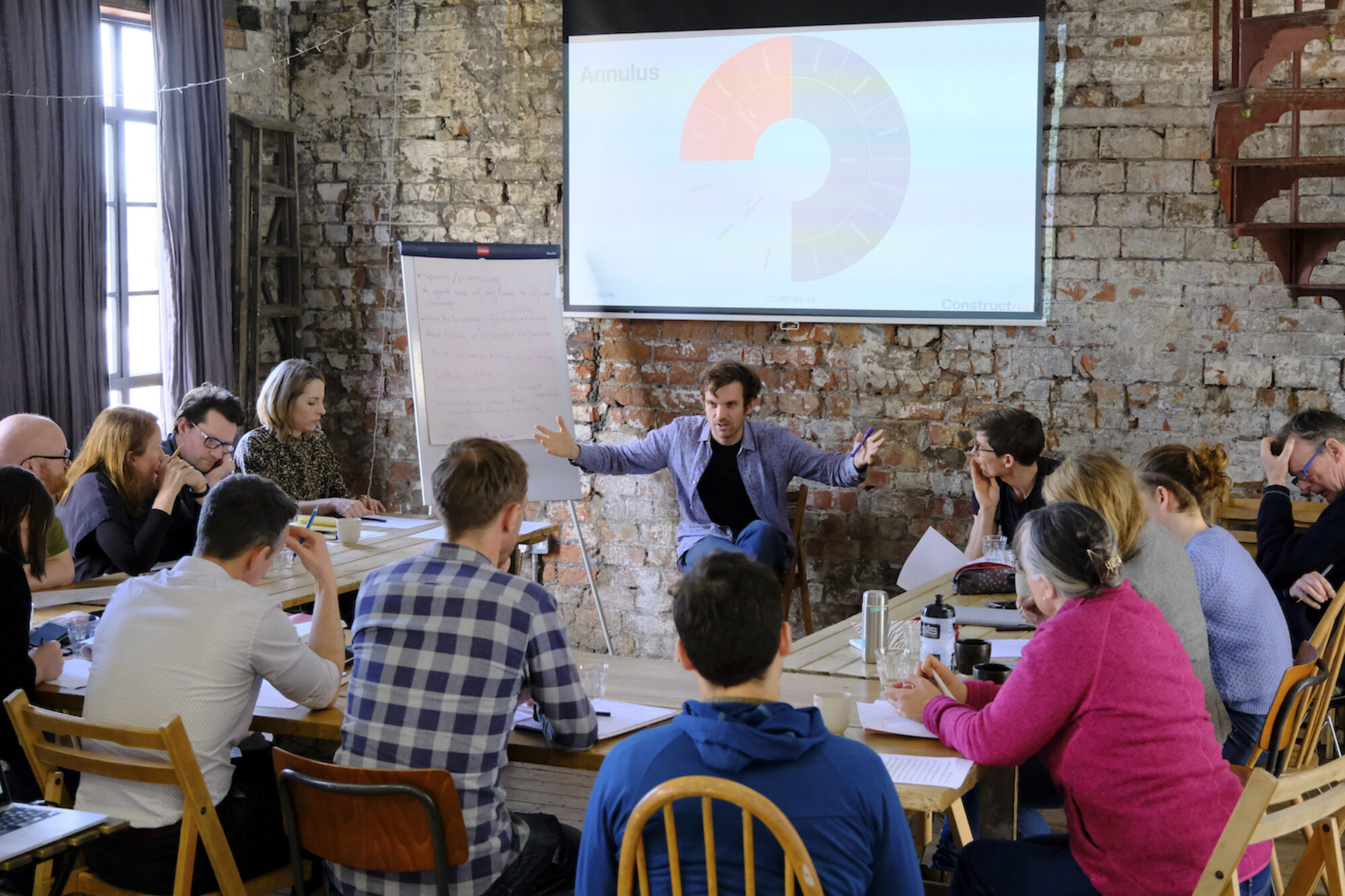

Set design for a training room

If your brief is to design the set for a theatre piece set in a construction industry training room, then make sure it includes the following:

White boards. Spare furniture. A clock that doesn’t work. 

Security blinds, locked shut to keep intruders out, as well as the sunshine. 

White board fluid.  Extension leads. TV on a stand. 

Unconnected audio equipment. Post-it notes. Antibacterial fluid. 

Green cables. Red cables. Blue cables. Yellow cables. 

Archive boxes. Abandoned teleconference equipment. 

Laminated instruction sheets. 

Flip chart architecture. Highlighters. Slips of paper with the wifi code. Speakers. Panel heater.

And a hat stand. 

Arguably (I am sure I have argued this before) learning should be the objective of a high-functioning company. We don’t just do a thing: each we do it, we learn from it and do it better. (Otherwise lessons learnt become lessons lost.)

If learning were the organisational objective,, then the training room wouldn’t look like this. 

It wouldn’t be a storage space for forgotten equipment and excess furniture. 

It would be the nerve centre of learning. A place that celebrates learning rather than treats the experience as second rate. 

Just imagine what that room would look like.
Pattern book field notes – action learning and continuous place-based design

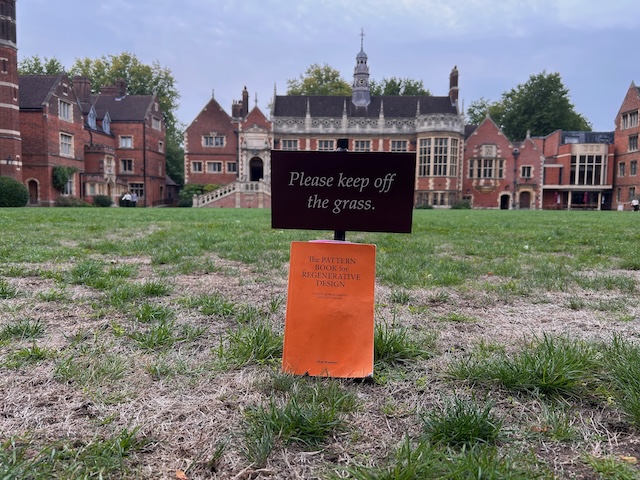
The Pattern Book for Regenerative Design is propped against a sign saying keep off the grass. In the backdrop is the quad of a Cambridge college

This week I took my copy of the Pattern Book to Cambridge. (Its second visit: in July I dropped it — and my laptop — in a puddle. Both recovered, and this time was less eventful.)

I was there to deliver my annual September workshop for the new cohort of students on the Sustainability Leadership for the Built Environment (SLBE) masters at the Cambridge Institute for Sustainability Leadership. Two Pattern Book entries featured strongly.

Continuous place-based design

The workshop was called Design your learning process. We began by asking: what is design? I asked students to sketch a diagram of design as they see it.

This is central to the Constructivist method: start where the learner is, then connect new concepts to what they already know.

After sharing diagrams, I introduced a series of design models, each adding a new dimension, until we reached the Continuous Place-Based Design motif. At each stage, I pointed to overlaps with the students’ diagrams.

The point isn’t to treat any model as a strict procedure, but to use it as something to compare with reality — and then think how we might shift that reality for the better.

Action learning

From there, we turned to the idea that continuous place-based design is really a learning process. Which led naturally to the Action Learning motif.

It’s easy to be passive in learning. The real value comes when we apply theory to practice and then reflect on the results. The Pattern Book entry for action learning even includes a script for running these conversations with colleagues.

This month, I’ve been in workshops on live infrastructure projects where the same theme has surfaced again: organisations struggling to learn from mistakes. Not lessons learned, but lessons lost. For me this underlines that action learning isn’t just a training method — it’s a principle for working in complex systems.

It is such a pleasure to teach on this course — this is the start of my eighth cohort! Many graduates are readers here, so if that’s you: thank you for sticking with me all these years.

Decide to remember or decide to forget

When we make decisions in complex scenarios, we can never be certain how they will work out. But every decision is an opportunity to test our thinking and to see how the system responds.

Every decision is a learning opportunity. Each is a chance to learn what happens when I make a decision based on certain factors rather than others.

But only if we decide to remember. 

That means writing down why we did what we did — and remembering to look back the next time we’re making a similar decision.