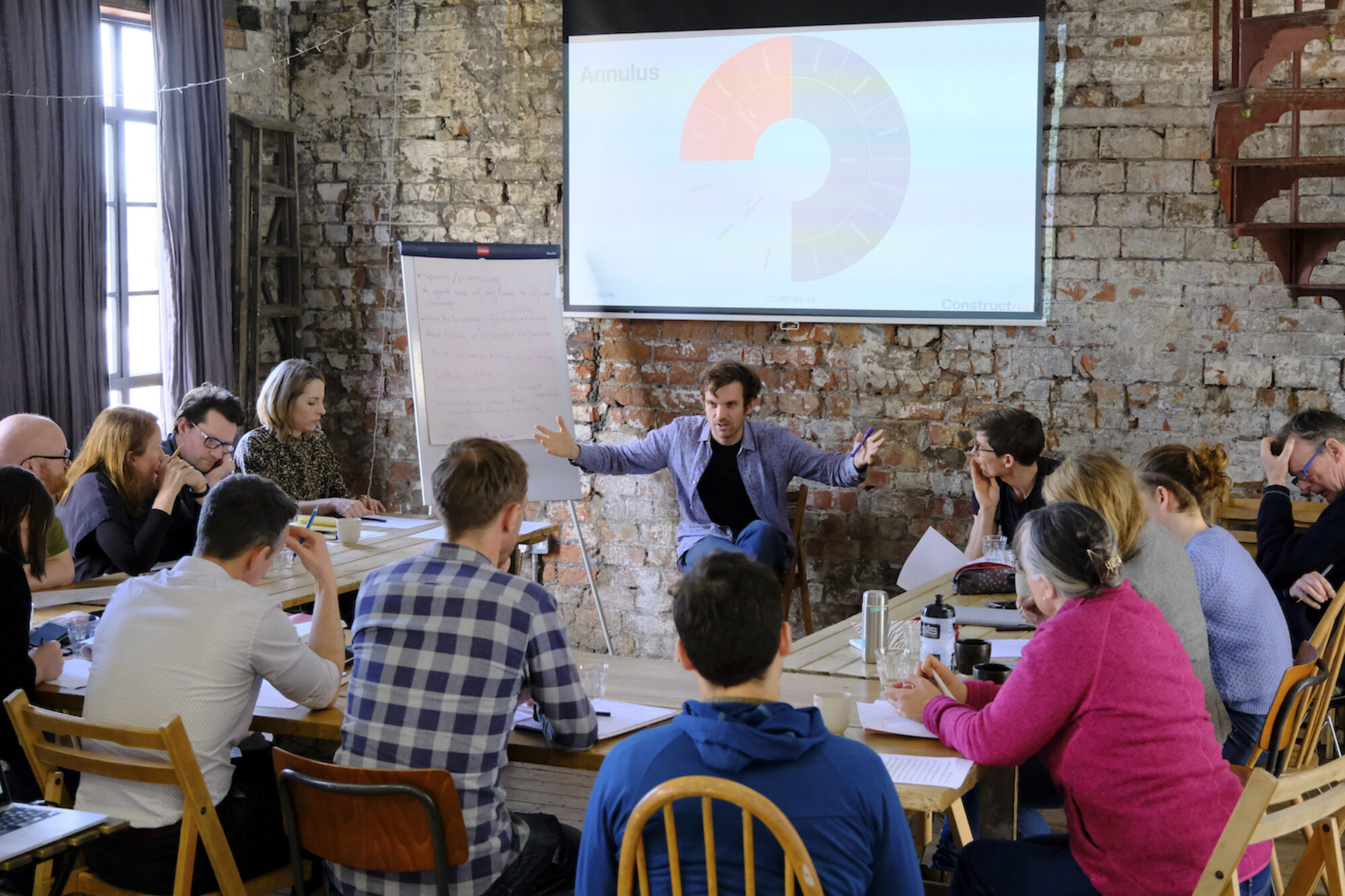

When we teach our How to Run a Good Workshop Workshop, we introduce four basic modes of facilitation:
- Presentation
- Breakout
- Guided Q&A
- Guided Plenary
We think of these as the building blocks of workshop design.
Different workshops aim to do different things. Some are for transmitting ideas, some are for understanding what a group thinks about something, some are for moving a group from challenge to action, and some are about generating ideas.
The Four Modes of Facilitation give us the basic building blocks from which we can build a workshop that achieves each of these aims.
For example, our Standard Workshop Format uses:
Presentation > Breakout > Guided Q&A > Breakout > Guided Q&A
to move a group from understanding the context, through identifying challenges, to generating ideas and agreeing next steps.
A different workshop might use the same building blocks in a completely different order.
Learning the Four Modes therefore gives you a simple, repeatable vocabulary for designing workshops rather than inventing new exercises each time. And if your colleagues know these building blocks, you can more easily collaborate to design and co-facilitate a good workshop.
Presentation — for transmitting information
Sometimes people simply need to know something before they can have a useful conversation. You might need to:
- explain the context
- introduce a model
- give some important background
- explain the task.
The key is to keep presentations short and clear. In a workshop, presentation is there to enable participation. It shouldn’t swallow up all the time that was meant for people to think together.
Whenever possible, presentation should be followed up with an opportunity for people to do something with the information afterwards: discuss it, question it, apply it or challenge it.
Breakout — for small-group discussion.
Breakouts create a small, safe space for people to engage with a question and in which ideas can emerge. They:
- allow many more people to speak
- give participants a chance to engage with something you have presented
- make it easier to explore questions people may not yet feel confident discussing in front of everybody
- generate ideas and experiences that can then be brought back to the whole group.
Give each breakout a clear question and be clear about what you want them to bring back. Usually we ask for two or three key points. This means the breakout has to do some synthesis rather than simply reporting everything that was said.
Tip: remind breakout groups to create this summary toward the end of their breakout time to avoid rambling feedback from breakout discussions.
Breakouts also give the facilitator useful information about the room. As you listen to the groups, you begin to spot people who have an interesting perspective or who seem confident talking about the subject.
Guided Q&A — for a whole-group discussion led by the facilitator
In this mode, the facilitator speaks from the front, but it is not presentation. Instead, the facilitator asks questions, listens, and summarises answers. You might use it to:
- hear back from breakouts
- explore something that has just been presented
- identify the questions in the room
- find areas of agreement or disagreement
- decide what the group should work on next.
It is more exposed than a breakout. Asking a question or offering an opinion in front of twenty people takes more confidence than saying the same thing to three people around a table. That is why Guided Q&A often follows a breakout session: you already know that people have had a chance to think and talk about the question, and you may have heard people make points that would be useful to bring into the whole-group conversation.
This is where the guided part of Guided Q&A comes in.
If you heard someone make an interesting point during a breakout, invite them in:
‘Gustav, I heard you talking about this on your table. Would you mind saying a bit about that?’
You can also deliberately invite people who haven’t spoken yet.
The aim isn’t to put people on the spot. It is to make it easier for the group to contribute.
Guided Plenary — allowing one person’s perspective to be explored in more depth
This is a more advanced facilitation technique. Imagine someone has an experience, problem or idea that would be valuable for everyone to explore.
You could simply invite questions from the room. But that leaves the individual quite exposed. Suddenly they have twenty people firing questions at them from different directions.
In a Guided Plenary, the facilitator creates a safe space around the individual. The conversation runs through the facilitator.
Someone in the audience might ask a question. Rather than leaving the participant to deal with it directly, the facilitator receives the question, decides how to use it and then puts an appropriate version of it to the individual.
Or they might decide that the question isn’t useful and move the conversation somewhere else.
The facilitator becomes a kind of membrane between the individual and the room.
This creates an interesting balance. You get the depth of an individual conversation while drawing on the curiosity and intelligence of the whole group.
The person at the centre is visible, but they are not left exposed.
Thinking about exposure
The safer participants feel, the more easily they contribute. One of the worst things we can do as facilitators is expose participants by putting them on the spot.
So how we sequence these building blocks matters. It is useful to think about how each of the modes might make participants feel.
- Presentation — participants mostly listen.
- Breakout — participants talk in a relatively safe, small group.
- Guided Q&A — participants speak in front of the whole room.
- Guided Plenary — an individual becomes the focus of the whole room’s attention, but the facilitator creates a safe space around them.
Building safety comes partly from the way the workshop has been structured: people having already spoken in smaller groups, participants knowing something about each other, the facilitator demonstrating that contributions will be treated respectfully, and people not being left hanging when they take the risk of speaking.
Stitching the modes together
The usefulness of the Four Modes comes when you start stitching them together. A workshop might go:
Presentation — here is a problem we need to think about
Breakout — what does the challenge look like from your perspective?
Guided Q&A — what are the important themes emerging for us?
Breakout — explore further the theme most important to you.
Guided Q&A — what did you discover and what should we do next?
This is essentially the structure of the Standard Workshop Format, but there are many other combinations.
For example, depending on what comes up as important themes, you might bring in a subject-matter expert to present some content, which can then be digested in breakout rooms.
Or if from one of the breakout sessions you discover someone who might be willing to talk in more depth about their personal experience, you could add in a Guided Plenary.
Beware: if you all your blocks are presentation sessions, you haven’t got a workshop, you’ve got a presentation!
Growing in confidence as a facilitator
As you become more confident, you can start to improvise more: extending a breakout when an interesting conversation is developing, switching into Guided Q&A when you need to hear from the room, or using an unexpected contribution as the starting point for a Guided Plenary.
You don’t need to script every conversation. You need a set of building blocks, a sense of what each one is good for, and enough confidence to move between them.
In this way, the Four Modes of Facilitation become the fundamental chords of good facilitation.