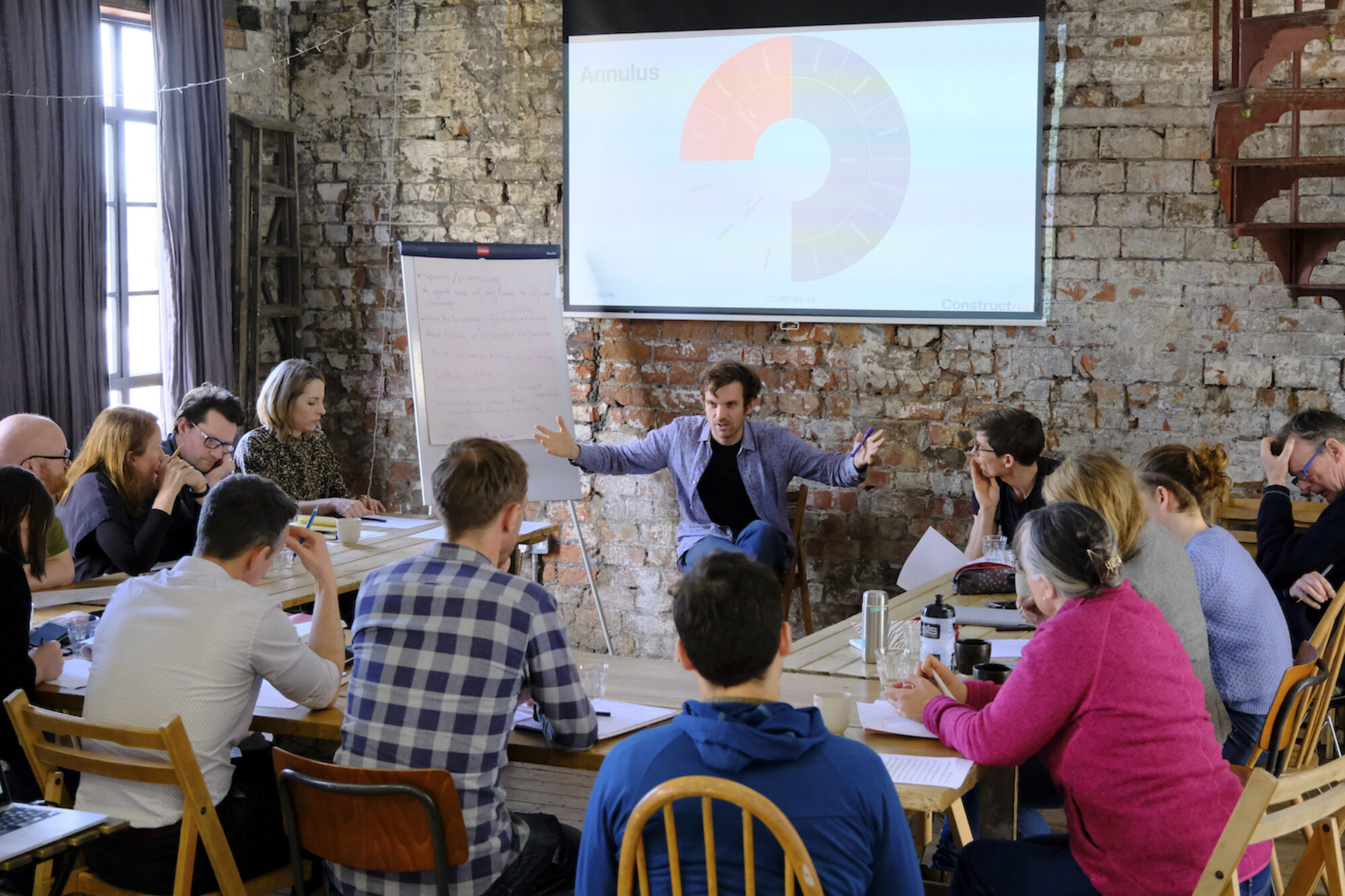

Here is a radical idea when learning to facilitate: a facilitator doesn’t need to know all the answers.
In fact, for many workshops, you need surprisingly little subject-matter expertise. What you need is a good process, confidence in the people you are working with and the ability to hold space while they do the thinking.
From a facilitator’s point of view, this can be hugely de-stressing. Facilitators often feel they need to come into the room ready to answer all the questions, generate ideas and somehow find the right answer for the group.
But the word facilitation comes from the idea of ‘making something easy’. Our job is to make it easy for people to have a good conversation.
You do that by creating enough structure for people to think together: giving them a question, making space for everyone to contribute, capturing what emerges, helping the group see patterns, and then moving the conversation towards action.
The content — what they talk about, what patterns they see, what ideas they have, what they decide on — comes from the people in the room.
This is the principle running through our training course How to Run a Good Workshop Workshop, and in particular a method we teach called the Standard Workshop Format.
When to use the Standard Workshop Format
The Standard Workshop Format works particularly well when you have a group of people facing a shared challenge and you suspect that, between them, they already know quite a lot about both the problem and what might be done about it.
In most situations, the people doing a thing know much more about it than external people coming into the situation, so the Standard Workshop Format is applicable in many scenarios.
It works for questions like:
- What’s getting in the way of us doing X?
- What are the biggest challenges we’re facing?
- What could we do differently?
- What should our priorities be?
- What should we do next?
In all of these contexts, the Standard Workshop Format is a reliable way to help build shared clarity and define next courses of action.
The format
The words in square brackets refer to the Four Modes of Facilitation.
1. Set the context
Briefly explain why you’re there, what you’re trying to achieve and what will happen with the output. This could be given by a client or someone with a good level of expertise in the area, or by you.
Keep this short. You are setting up the conversation, not giving a lecture.
2. Explore the challenges
Put people into small groups and give them a clear question. For example:
‘What are the biggest barriers you face in achieving a particular goal?’
Ask each group to discuss the question and agree two or three key points to bring back.
That last instruction matters. Without it, the report-back can become a blow-by-blow account of every conversation. Asking for two or three points forces some useful synthesis.
3. Capture the top challenges/issues
Bring everyone back together and hear the key points from each group.
Capture them on a piece of flip-chart paper so everyone can see.
The facilitator’s job here is primarily to listen, clarify and capture—not to judge the answers.
4. Build the agenda
You will probably now have more challenges than you can sensibly work on.
Sort them. You might combine overlapping ideas, invite people to vote on the biggest challenges , or simply use your judgement to identify a handful of recurring themes. You are moving from everything we know towards the things worth spending our limited time on.
You are building the agenda for the second half of the workshop.
5. Take a break
This is the ideal time for a break as you transition from problem identification to solution thinking.
6. Explore solutions
Run a second set of breakouts, this time around the priority challenges. Set one breakout per challenge and let participants choose which challenge they want to work on.
The question changes from something like: What’s getting in the way?
to:
What could we do about this? or What’s a useful next step?
Again, ask groups to come back with a small number of key points.
7. Gather the possibilities
Hear back from the groups and capture the possible solutions or next steps.
Ask questions where extra clarity is needed.
8. Identify actions
Finally ask: So what are we actually going to do?
Identify actions, owners and—where useful—timescales.
Why it works
Overall, the format is fairly simple:
Context>Issues>Biggest issues>Ideas>Things to try.
That’s why it’s so applicable.
It alternates between small-group conversation, where participation and exploration are easier, and whole-group sense-making, where a collective picture can form.
How long does it take?
You can squeeze the whole thing into an hour, particularly with a small group and no break.
But 90 minutes is much better. People have time to think, the report-backs aren’t as rushed, and you can allow the conversation to go somewhere slightly unexpected.
It works well for groups of up to about 20 people. Beyond that, the difficulty isn’t generating ideas; it’s assimilating all the input without the plenary becoming cumbersome.
For larger groups, you need to change the mechanics.
Practice
The format is easy to learn. What comes with practice is holding it lightly and resisting the temptation to provide all the answers yourself.
The Standard Workshop Format works because of the abundance knowledge and experience in the room. Your job as a facilitator is to make it easy for that abundance to come out.