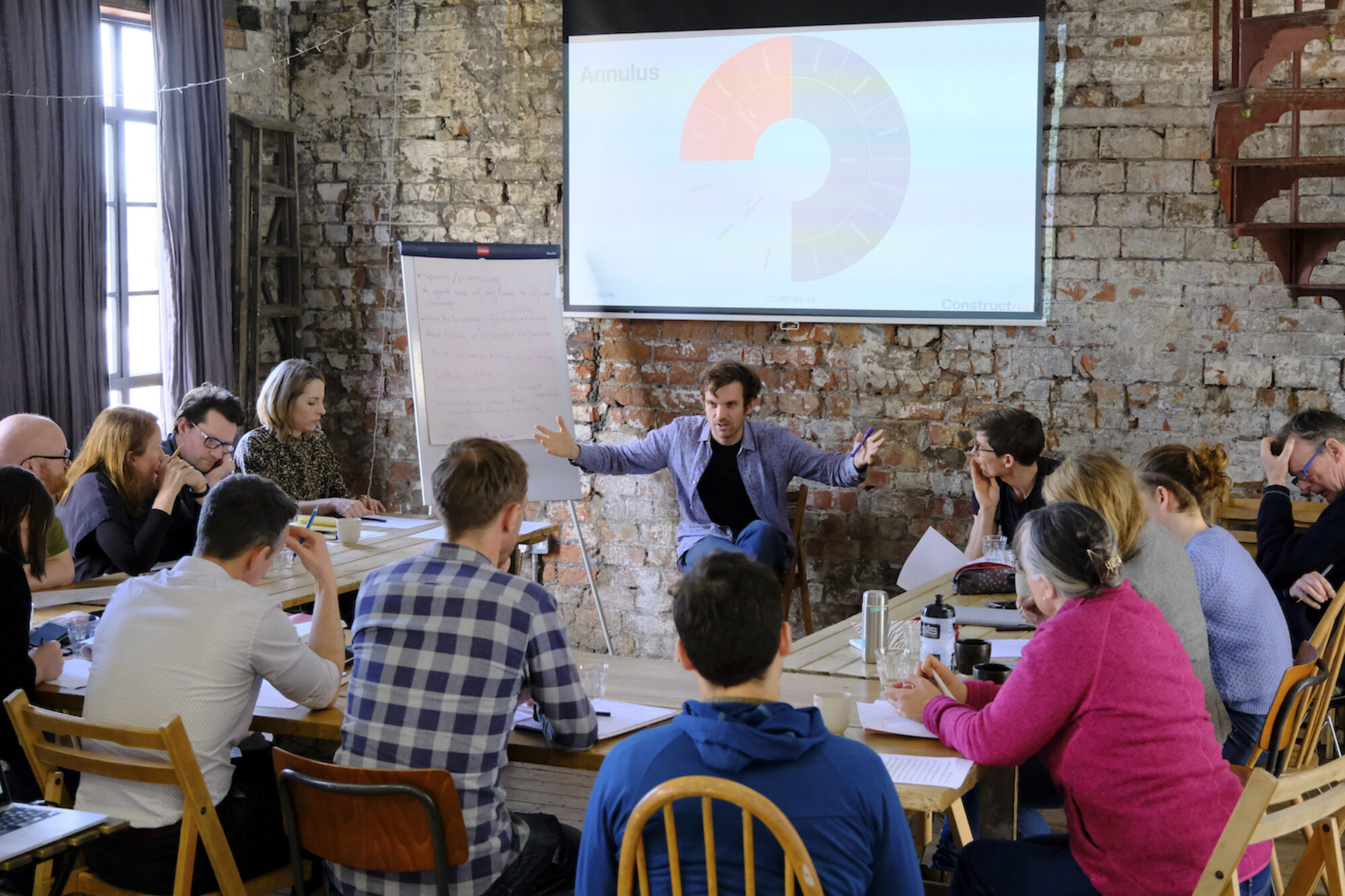

All week we’ve been interviewing candidates for Cohort 6 of the Regenerative Design Lab. With such a strong range of applicants, it’s been a real privilege to spend time with so many thoughtful, committed humans.
And it’s not just us asking the questions.
Candidates ask us questions too, as they decide whether they want to commit to this journey. One question, in particular, keeps coming up, what does a good outcome for a cohort look like?
Over the week, my answer has been converging on a clear image.
The Lab is a facilitated, carefully scaffolded process. We design the conditions, hold the space, and guide the learning. But that’s not the end goal.
Over time, something else begins to happen.
Cohorts start to form their own connections.
People rely on one another, not just on the facilitators.
Support, challenge and learning begin to circulate within the group.
The process starts to become mutual.
Participants bring energy, insight and care — and receive it in return. The cohort starts to function less like a programme and more like a living system, sustained by the quality of its relationships.
As confidence grows, the group becomes more able to respond to what emerges. New questions surface. Directions shift. The cohort adapts — not because it was pre-designed to do so, but because the conditions allow it.
Our hope is that, over time, a cohort develops enough of its own energy to sustain itself. That it unlocks the abundance already present in the group, rather than relying on continued external input.
When that happens, the role of facilitation begins to fall away.
The cohort can fly on its own.
Not dependent on us.
Not dependent on funding.
Sustained by what participants create, share and renew together.
Interconnection.
Symbiosis.
Capacity to adapt.
A system that draws on renewing, abundant resources rather than depletion — and continues because it wants to, not because it is being held in place.
For me, that is a deeply regenerative outcome.