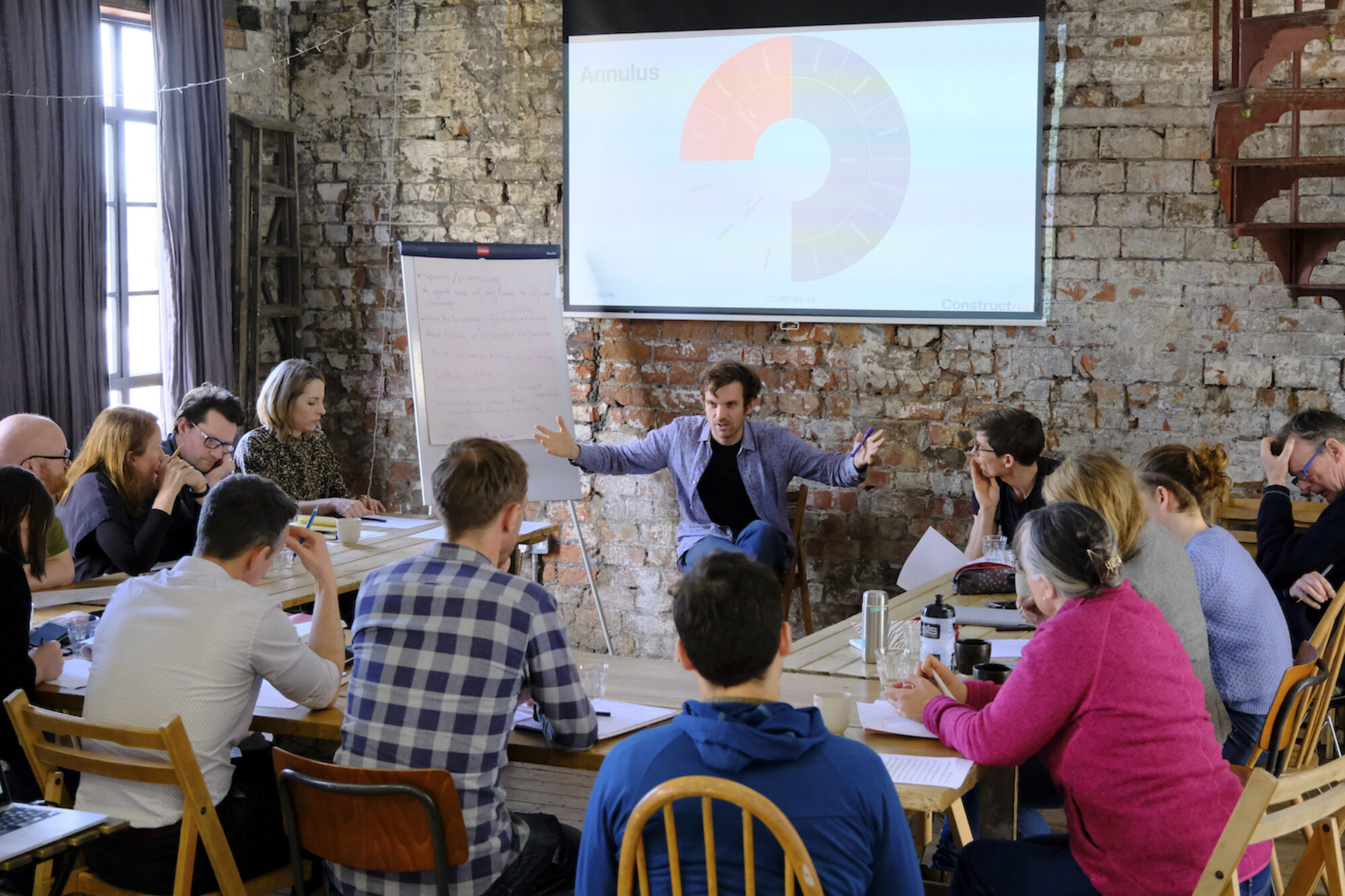

Facilitation is an intense business. It requires you to read lots of social cues and to judge what’s the best next step. It’s not surprising therefore that when travelling home in the train from a workshop I usually drift off, the sway of the carriages gently quickly sending me to sleep.
And it was in that just-before-sleep moment that I realised I had no way of knowing if I was moving forwards or backwards. Once the train had reached a steady state there was no impulse forwards or backwards, just the jostling and shaking of the carriages. With my eyes closed, I couldn’t see. And it was dark outside in any case. For all I knew we could have been stationary and just shaking on the spot..
Cue a metaphor for how we perceive change. If we are in the daily hustle and bustle of delivering projects, all we feel is the shaking and the jostling. If we can’t see into the distance we can’t see if we are getting closer and further away.
Back in the train, when the driver accelerates we feel pushed in to our seat (or pulled slightly out if we are facing backwards). But acceleration in organisational systems change is often much more imperceptible. We might not know it until things get out of control or ground to a halt.
So what can we do? Try this:
- Ask what would it means to see the horizon? Maybe it’s something external to your daily frame of reference. Are you getting closer or further away?
- Ask what it would it mean to see the rate of change? This might mean trying to find some sort of trace. Eg – Invoices, customer queries, sick days, species count, maintenance outages. How does that of these compare to last year?
If we can access these external frames of reference, we can start to understand our direction of travel, speed and acceleration.
The Living Systems Blueprint is our tool for assessing progress towards regenerative systems outcomes. Its three components – interconnection, symbiosis and capacity to change – give us a direction of travel and a framing for assessing progress.
Whether you use this framing or a different one, we need external reference to check our progress.
Without them we might just be busily shaking on the spot.