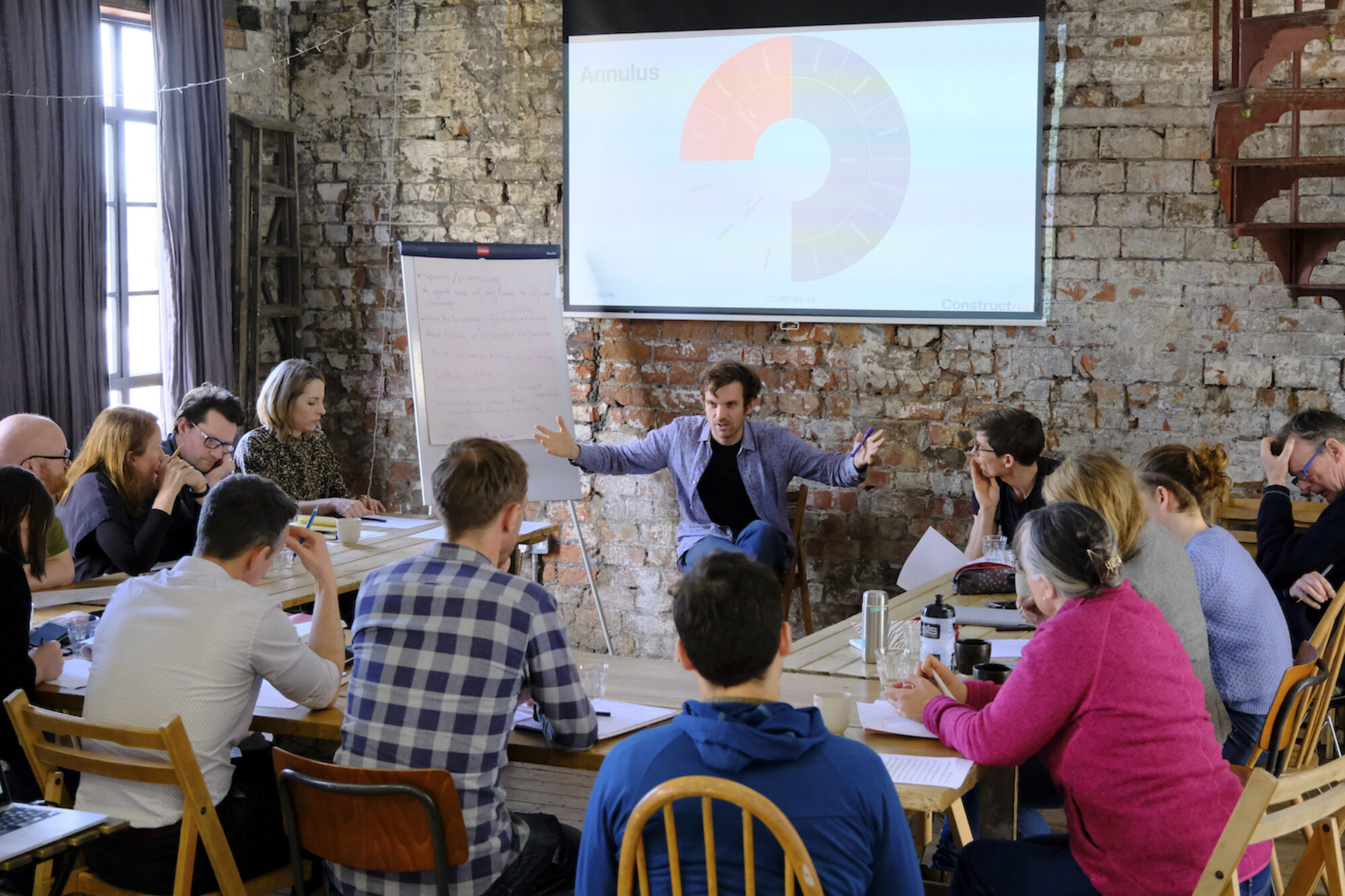
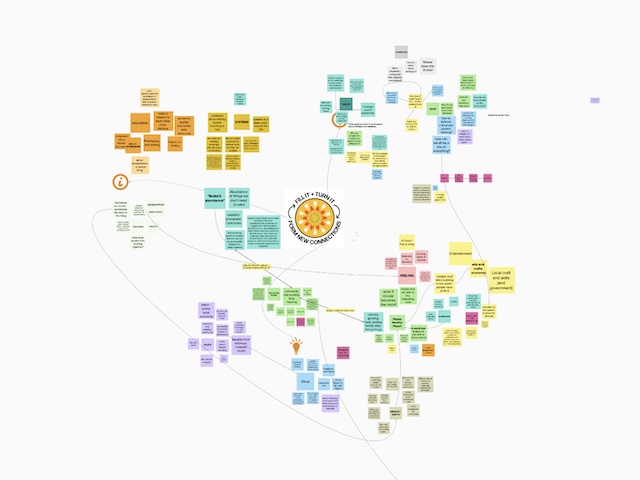
This month at the Regenerative Design Lab, Cohorts 6 and 7 both spent time on line imagining the future.
Using the Three Horizons model, we explored Horizon Three, not as a prediction tool but rather as a canvas for finding shared hopes for the future.
We structured the conversation using a Kalideascope — a tool central to our design teaching at Constructivist. And this makes sense because as designers we are constantly imaging the future. What changes here is that the principal ingredient to the process is our hopes for the future.
A pattern I am spotting is how much common ground emerges in these sessions. Themes of connection, community, stewardship, making and different ways to find meaning emerged. And along side these, lots of examples of different ways that these futures exist in the present, there to be cultivated, encouraged, supported, connected up.
I think most valuable is that people didn’t leave with a single vision of the future but a long list of ideas for experiments, practices and actions.
Over the coming months, the Lab will move into the next phase of the journey: designing experiment sand looking for ways to create transitions to that more hopeful future.
This week at the Regenerative Design Lab, we’ve been working with the Living Systems Blueprint — a model for connecting high-level regenerative thinking with more tangible design decisions.
The Blueprint identifies three qualities common to living systems. One of these is interconnection.
Thriving living systems tend to have high levels of local connectivity:
contact between species, relationships of co-dependency, flows of information and energy.
A good example is the mycelial networks that connect trees in a woodland. These networks allow feedback to travel through the ecosystem, helping the system adapt and stay in balance.
One feature of the industrialised human economy is just how separated we have become from the living systems that support life on Earth.
So interconnection becomes a useful design prompt.
How might we design more feedback into systems?
How might we reconnect supply chains to ecosystems?
How might we strengthen relationships between people, place and the living world?
Interconnection as a topic comes up in so many ways:
How do we connect with the systems that surround us?
How does information travel through supply chains?
How can we we pay attention to the signal when there is so much noise.
It’s a common thread running through much of this blog.
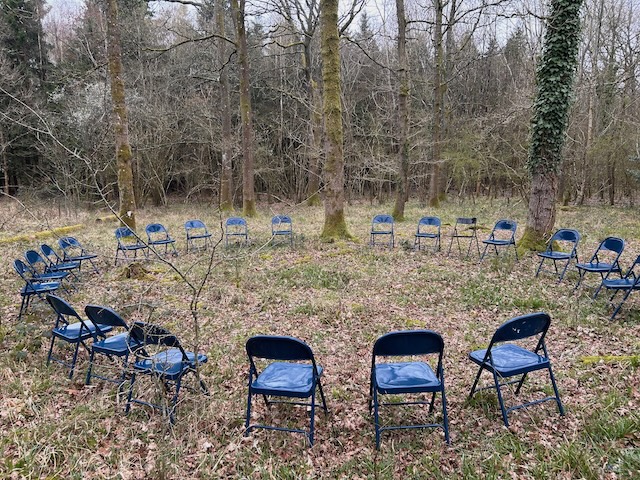
20 chairs in a circle by the Gatekeeper tree at Hazel Hill Wood
It’s a deliberate place to start. For many, it’s the first time meeting each other face to face. And the first time meeting the wood.
Because the wood isn’t just a venue. It’s part of the work.
A thriving ecosystem. A container for learning. A place for discovery. A reminder of abundance, complexity, and timescales far beyond our projects.
And so we begin our inquiries here — deliberately stepping away from the pressing needs of day-to-day work, and into something slower, more exploratory.
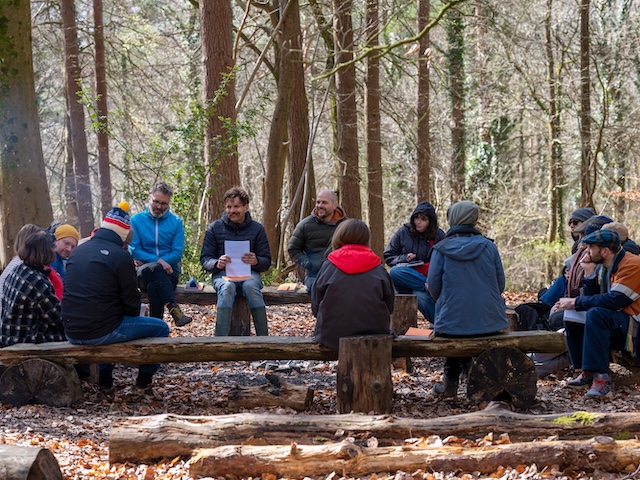
Lab participants gather around the fire to discuss how regenerative design relates to their work — photo credit, Steve Cross
We don’t pretend the real world works like this. But this is a place we can return to — for perspective, recovery, and renewed energy to carry on the work of system change.
Everyone arrives with a Pattern from the Pattern Book, chosen as a guide through the Lab.
Over the first afternoon, we move through the wood. Three distinct habitats, each chosen to represent a different regenerative mindset. Each paired with a simple game and time for reflection.
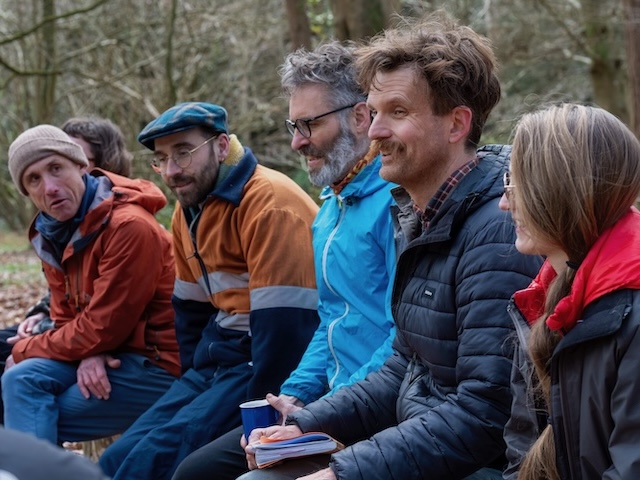
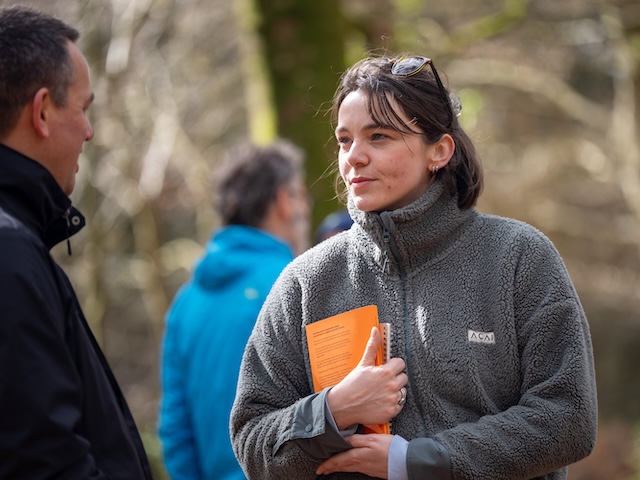
Two lab members in discussion during one of our exercises exploring mindsets for regenerative design — photo credit, Steve Cross
Some of the work is quiet. Observing. Noticing.
Some of it is more active — testing ideas, asking questions, beginning to see how each person’s inquiry might take shape.
And some of it is unexpectedly playful.
There are moments of seriousness — conversations about organisations, systems, and the challenges of making change stick.
And then, at other times, we find ourselves in something like satsuma jousting.
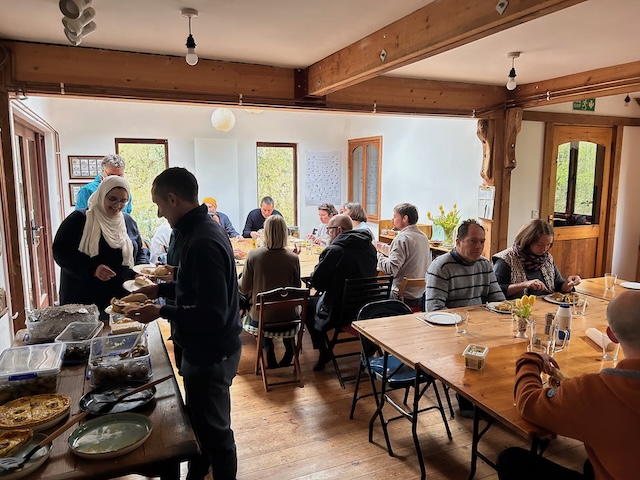
Delicious food and lots of it — a key ingredient of the residentials at Hazel Hill Wood.
It’s easy to see these as opposites. But in practice, they are part of the same work. Play creates space. It changes how people relate. It allows new ideas to emerge that wouldn’t surface otherwise.
By the second day, the focus turns more directly to each person’s inquiry.
We work with the Systems Bookcase, exploring how different levels of a system interact — from underlying paradigms through to design decisions.
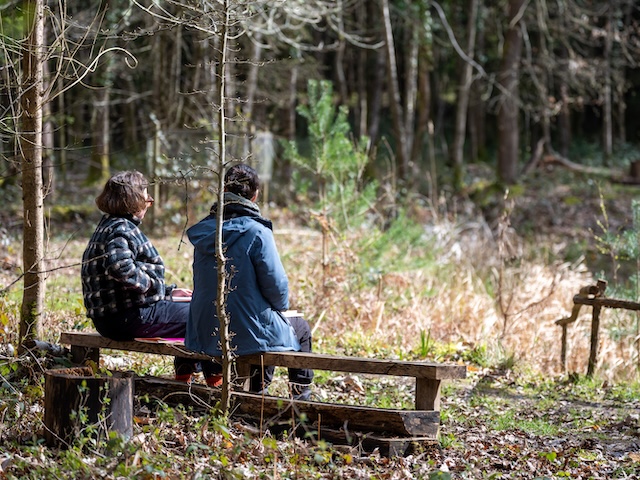
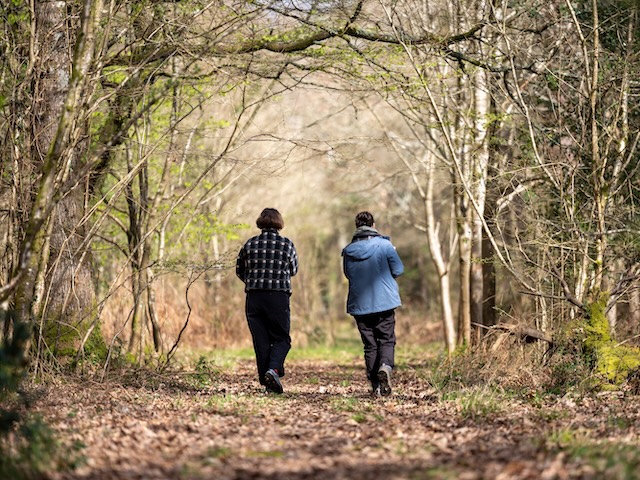
Two people on a reflective walk along a path at Hazel Hill Wood — photo credit, Steve Cross
Then back out into the wood again — in pairs, and then alone.
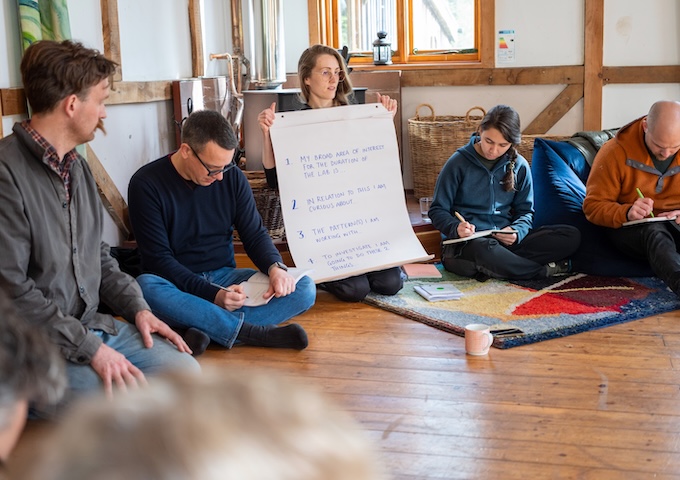
Why have I come here?
Within this broad area of interest, what am I actually curious about?
What pattern am I working with?
And what might I try next?
Lab facilitator Ellie Osborne lists four reflective questions for the solo walk in the woods — photo credit, Steve Cross
These aren’t intended to be final answers, rather, best next answers for now.
By the end, the group leaves the shelter of the wood and returns to their projects, organisations, and everyday constraints.
But not quite in the same way.
Because now we are observing, asking questions, looking for opportunities, looking for the lever that we will pull, the change that we will experiment with.
We’ll gather again here in the summer to share what we have discovered so far.
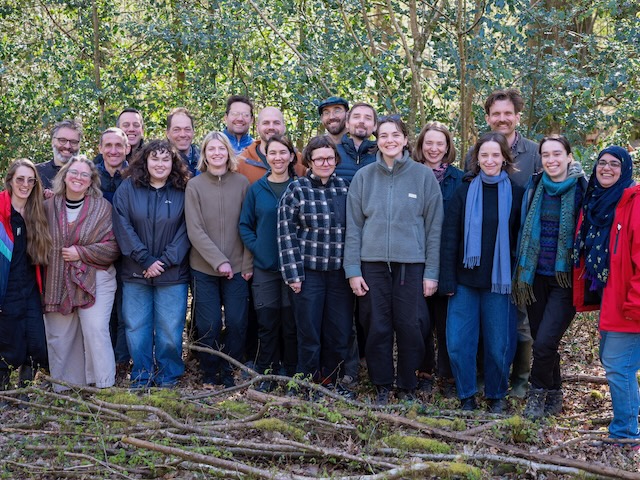
Cohort 6 at the end of their spring residential — photo credit, Steve Cross
This March we are holding the Spring Residential workshops for Cohort 6 and Cohort 7 of the Regenerative Design Lab. Appropriately I was down at Hazel Hill Wood this weekend for the wood’s Wood Chop Challenge — the annual event that provides firewood for that heats the retreat buildings used by many groups who come to the wood to learn, including the Lab.
For me this process captures something of the essence of regenerative practice.
The firewood is both product and process.
It both meets a human need — staying warm and comfortable while in the wood. And it meets the wider need of the ecosystem through careful management of the woodland. And, what’s more, the work of producing it — felling, chopping, transporting and stacking — becomes part of the experience of that place.
In that sense the Wood Chop Challenge is a small example of what regenerative practice can look like: meeting our needs while strengthening the living systems we depend on.
You can read more about it on the Hazel Hill website here.
Next week we begin a new experiment at the Regenerative Design Lab: we are starting our first alumni cohort.
Cohort 7 will be for returning practitioners — engineers (and other humans) who have been through the Lab before. Some applied as long ago as 2022.
That wasn’t so long ago in terms of building design ago, but in the field of regenerative design, which is emerging quite quickly, it feels like an age away.
In those first discussions, we had a strong pedagogy of enquiry, but the language was still forming and the frameworks emerging.
Since then the field has moved on and so have we. We have much better models and clearer patterns to work with. The connection between regenerative practice and day-to-day business can be more clearly articulated.
But more importantly the participants have moved on.
They’ve been in practice. They’ve tested ideas. They’ve discovered where the limits really sit and where they have been able to push.
And the operating conditions have changed too. The urgency has deepened. The need for thinking that is life-enabling rather than life-depleting is more acute.
So while Cohort 7 is a second journey, it is not a repeat because we return with more experience, new questions and opportunities.
This year we are also running Cohort 6 – our latest open cohort – in parallel. There’s something powerful I n this too: two groups moving through similar terrain but at different stages in their path. We’re curious to see what synergies develop between them, especially as we bring the two cohorts together for our final even in November.
Regenerative design is rooted in loops and cycles. I’m looking forward to seeing what this second cycle yields for our Cohort 7 participants.
Some of these I read a while ago, one I am still reading, but I’m including them to make explicit something that has been strengthening in the Lab: the role of play, attention and emergence.
Not just in how we facilitate. But in how we design. And how we show up.
Regenerative design isn’t just about feedback loops and systems levers. It is also about attention, tuning in, humility and sensing the audience — whether that’s a client, a colleague, a community or an ecosystem.
It is a whole world imagined of living within ecological limits. It is where I return to for grounding and new challenge.
Updating the list each year feels like a good spring ritual.
Regenerative practice is a vast field and this list represents just my intellectual journey, and not the whole cannon. I’d love to carry on widening this list, and I welcome recommendations… but as I am very slow reader (it only seems to go in if I write things down)… it may take me a while to get to them.