
Constructivist Timber part 1 – a micro supply chain

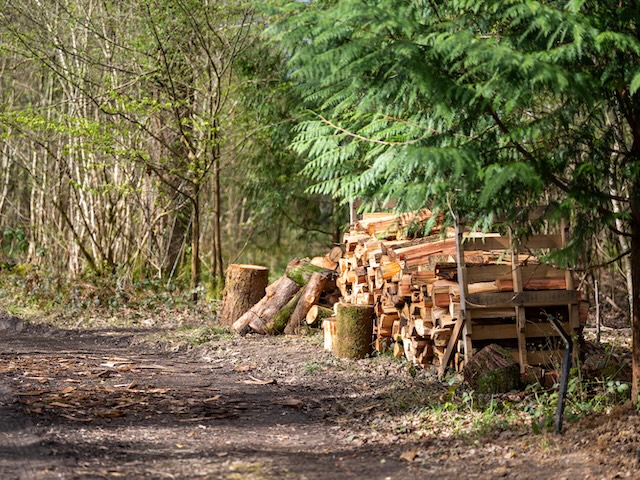
A wood stack beneath an evergreen tree, with a track going into the distance in the left

As I reached the end of my 1851 Fellowship in Regenerative Design I had the feeling I wanted to do more with my hands – I wanted more practice to accompany the theory. 

This feeling crystallised last summer, visiting family in western Canada last summer, including my cousin Wayne Wenstob, who inspired me to become a structural engineer in my twenties, and to whom the Pattern Book is dedicated. 

It was while staying there that they took delivery of a mobile saw mill. I watched while a group of people assembled the machinery on the beech and used it to process cedar drift wood. The timber was going to be used to renovate a traditional First Nation longhouse. 

Something clicked.

Half a planet away, at Hazel Hill Wood — home of the Regenerative Design Lab — we have just been granted our new forestry licence. 

After having lapsed for a few years, this gives us permission to fell trees as part of a longer-term shift: from areas of single-species forestry to mixed, resilient woodland.

But here’s the catch. 

Timber ‘in the round’ — unsown — has very low value. Often not enough to cover the cost of felling and extraction at small scale. 

But as I learnt in Canada, cutting the wood into planks significantly increases the sale value of the timber. 

And so an idea was born. What if Constructivist set up a new division, Constructivist Timber, to go into partnership with Hazel Hill to create a small, local timber supply chain?

Nothing large-scale, nor industrial. Just enough to process timber into usable planks, for use on site and then for sale is a modest revenue stream?

In regenerative design we often talk about unlocking stacked, multiple benefits in a system. This ideas seems to do that:

  • Thinning plantation stands supports the shift to mixed woodland.
  • Timber becomes both fuel and building material — reconnecting the charity to its own resources. 
  • Skills and craft knowledge could begin to circulate locally.
  • The Lab gains a way to practise continuous place-based design — not just talk about it.

At Hazel Hill Wood, this approach also reconnects something that had quietly drifted. The earliest buildings on site used timber from the wood itself. More recent construction has relied on commercial supply chains. Re-establishing an on-site timber flow brings that relationship back into view.

How we live with trees becomes part of the lived experience of the place. 

So the next logical step was clear: invest in a mobile sawmill.

And then two remarkable things happened

A local natural artist, Zac Newham (natural-art.uk) asked if he could store his mobile sawmill on site in return for us being able to use it. 

And the Engineering Club asked if it could book the wood to run its summer school, in which engineers will use timber from the wood to build infrastructure on site. 

It feels like by joining the dots we are already starting to unlock something abundant.

The first chapter of Constructivist Timber begins.
Spring at the Regenerative Design Lab

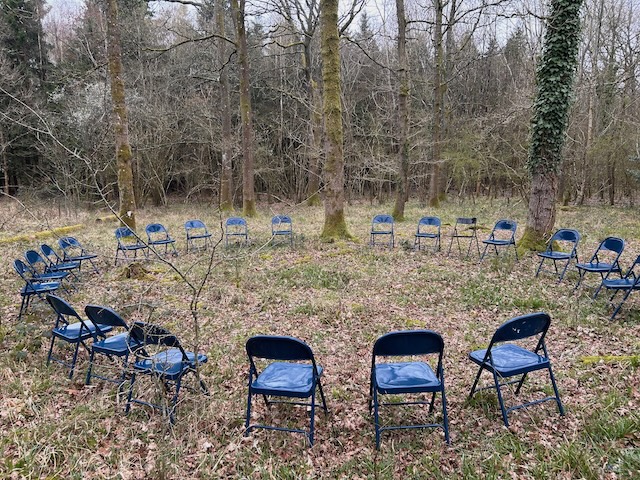
20 people sit in a circle.

The chairs are arranged between seven oak trees, right at the edge of Hazel Hill Wood — the home of the Regenerative Design Lab.

20 chairs in a circle by the Gatekeeper tree at Hazel Hill Wood

It’s a deliberate place to start. For many, it’s the first time meeting each other face to face. And the first time meeting the wood.

Because the wood isn’t just a venue. It’s part of the work.

A thriving ecosystem. A container for learning. A place for discovery. A reminder of abundance, complexity, and timescales far beyond our projects.

And so we begin our inquiries here — deliberately stepping away from the pressing needs of day-to-day work, and into something slower, more exploratory.

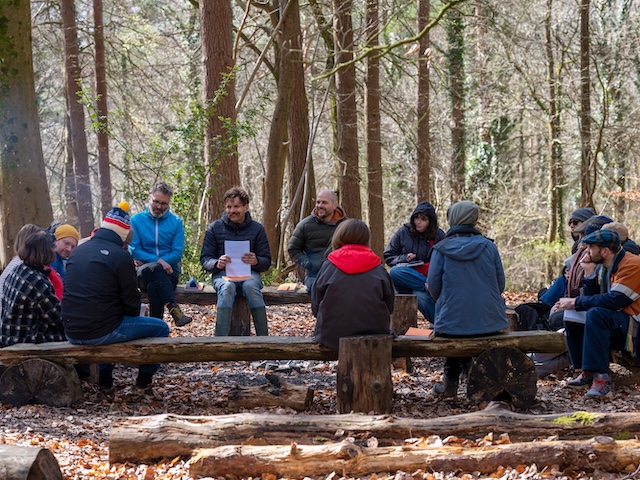
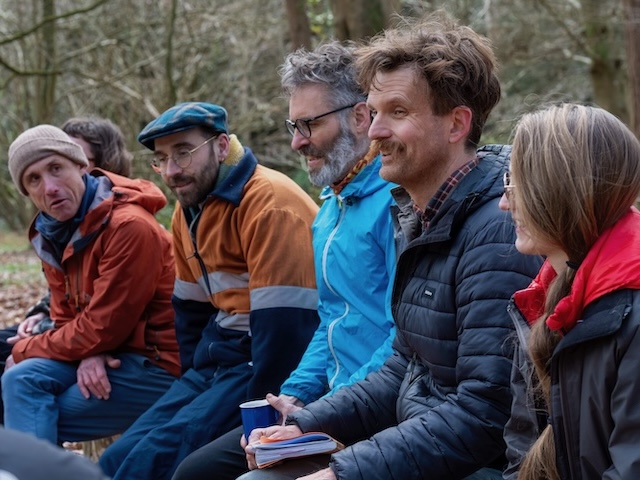
Lab participants gather around the fire to discuss how regenerative design relates to their work — photo credit, Steve Cross

We don’t pretend the real world works like this. But this is a place we can return to — for perspective, recovery, and renewed energy to carry on the work of system change.

Everyone arrives with a Pattern from the Pattern Book, chosen as a guide through the Lab.

Over the first afternoon, we move through the wood. Three distinct habitats, each chosen to represent a different regenerative mindset. Each paired with a simple game and time for reflection.

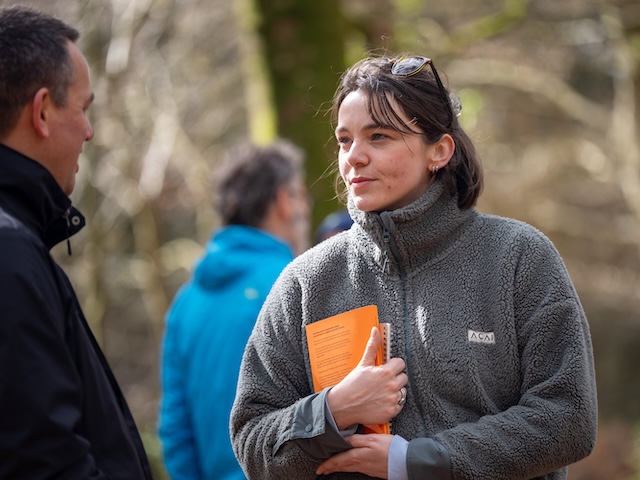
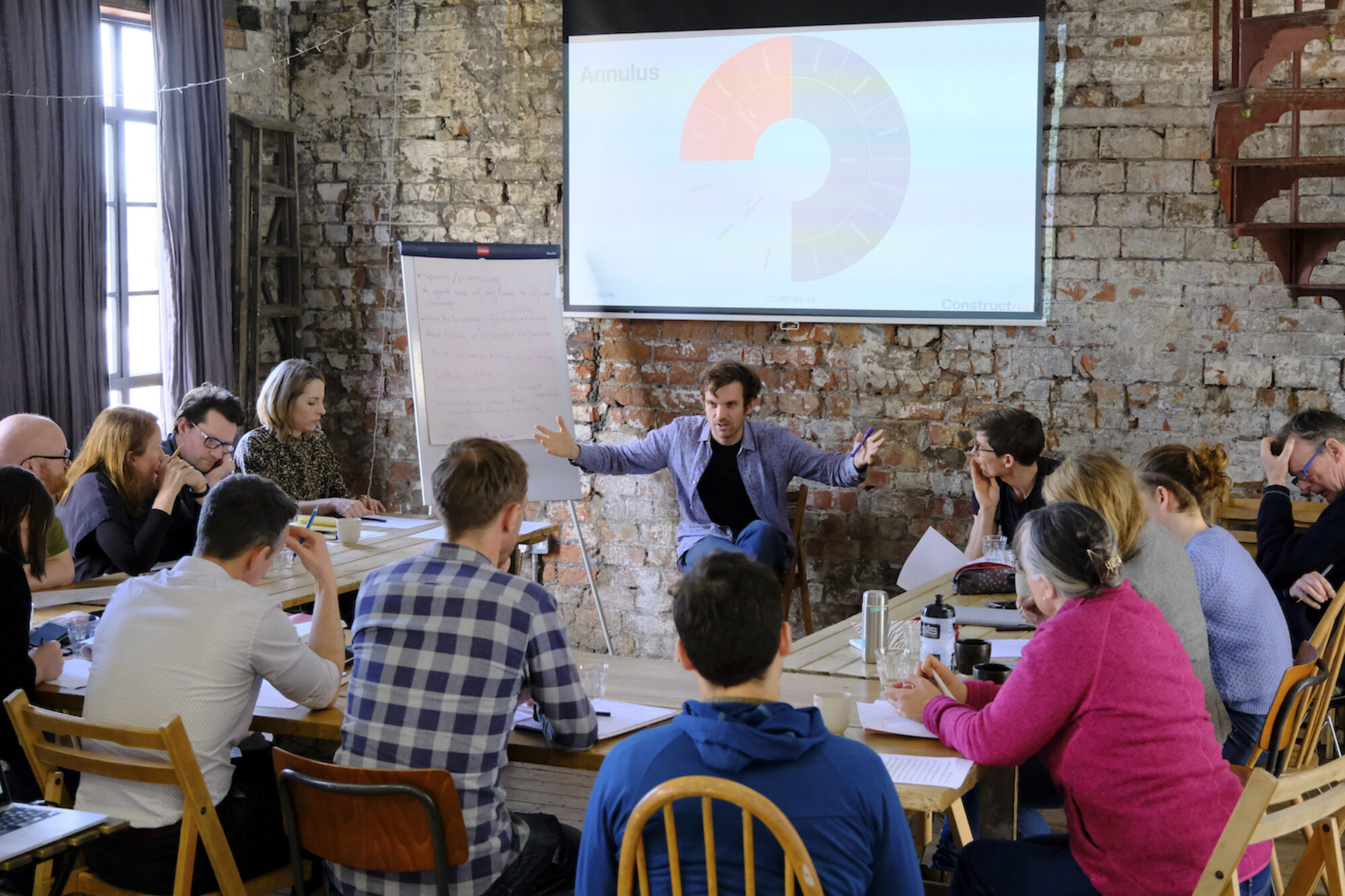
Two lab members in discussion during one of our exercises exploring mindsets for regenerative design — photo credit, Steve Cross

Some of the work is quiet. Observing. Noticing.

Some of it is more active — testing ideas, asking questions, beginning to see how each person’s inquiry might take shape.

And some of it is unexpectedly playful.

There are moments of seriousness — conversations about organisations, systems, and the challenges of making change stick.

And then, at other times, we find ourselves in something like satsuma jousting.

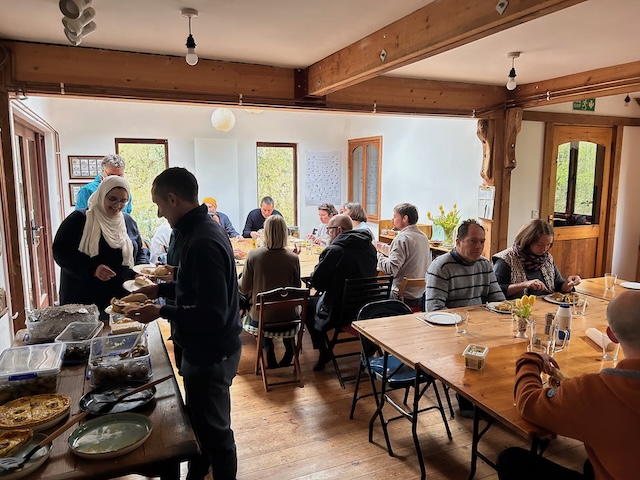
Delicious food and lots of it — a key ingredient of the residentials at Hazel Hill Wood.

It’s easy to see these as opposites. But in practice, they are part of the same work. Play creates space. It changes how people relate. It allows new ideas to emerge that wouldn’t surface otherwise.

By the second day, the focus turns more directly to each person’s inquiry.

We work with the Systems Bookcase, exploring how different levels of a system interact — from underlying paradigms through to design decisions.

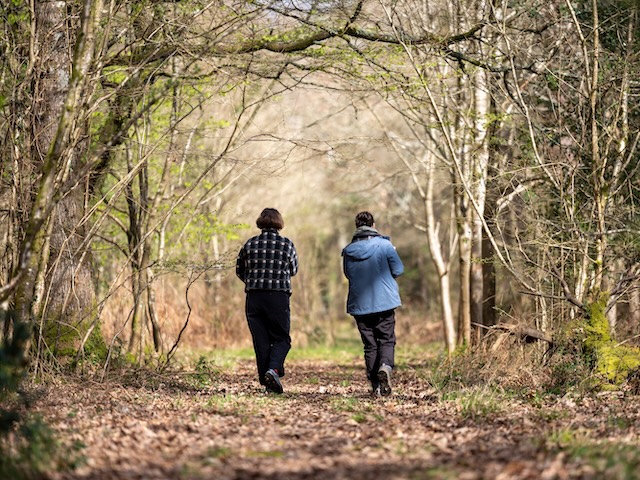
Two people on a reflective walk along a path at Hazel Hill Wood — photo credit, Steve Cross

Then back out into the wood again — in pairs, and then alone.

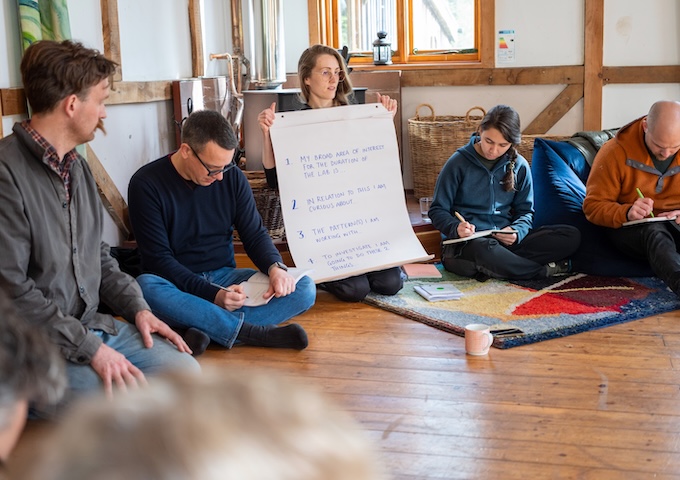
  • Why have I come here?
  • Within this broad area of interest, what am I actually curious about?
  • What pattern am I working with?
  • And what might I try next?
Lab facilitator Ellie Osborne lists four reflective questions for the solo walk in the woods — photo credit, Steve Cross

These aren’t intended to be final answers, rather, best next answers for now.

By the end, the group leaves the shelter of the wood and returns to their projects, organisations, and everyday constraints.

But not quite in the same way.

Because now we are observing, asking questions, looking for opportunities, looking for the lever that we will pull, the change that we will experiment with.

We’ll gather again here in the summer to share what we have discovered so far.

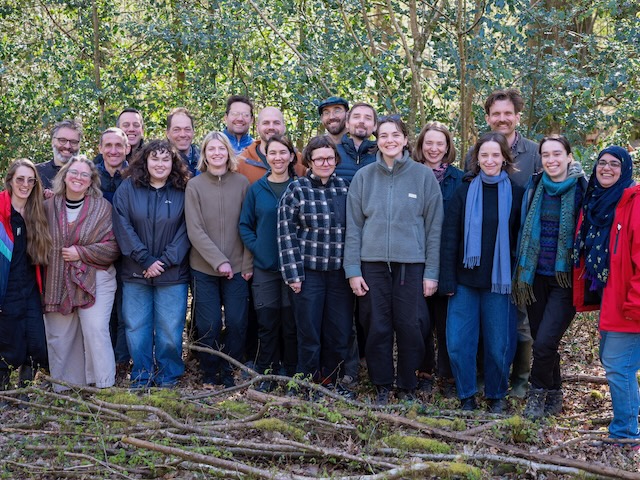
Cohort 6 at the end of their spring residential — photo credit, Steve Cross

Fuelling the Regenerative Design Lab

This March we are holding the Spring Residential workshops for Cohort 6 and Cohort 7 of the Regenerative Design Lab. Appropriately I was down at Hazel Hill Wood this weekend for the wood’s Wood Chop Challenge — the annual event that provides firewood for that heats the retreat buildings used by many groups who come to the wood to learn, including the Lab.

For me this process captures something of the essence of regenerative practice.

The firewood is both product and process.

It both meets a human need — staying warm and comfortable while in the wood. And it meets the wider need of the ecosystem through careful management of the woodland. And, what’s more, the work of producing it — felling, chopping, transporting and stacking — becomes part of the experience of that place.

In that sense the Wood Chop Challenge is a small example of what regenerative practice can look like: meeting our needs while strengthening the living systems we depend on.

You can read more about it on the Hazel Hill website here.

The dream walk experiment at Hazel Hill Wood

Last week at Hazel Hill Wood we ran a ‘dream walk’ with staff and trustees. The aim was to tune into our long-term hopes and aspirations for the site, as we continue the responsibility of creating a thriving place for care and learning.

Hopes and dreams are part of what a place is trying to do. They arise from our relationships with place and help steer the flow of change.

We began with Zuma Puma’s Box-Clearing warm-up (a technique I learnt from one of my clown teachers —more on that in another post), then set out into the woods. The rules were simple:

  • Walk to a place in the wood.
  • Walk with your gaze slightly raised to invite in fun and curiosity (another technique from another clown teacher, Robyn Hambrook) 
  • Share what you’ve always hoped for this place.
  • Imagine how it could be, how it might change.
  • Speak until you’re done.
  • The next person picks up — not to challenge, but to add their own dreams.

We captured dreams in audio and notes, later mapped across the site.

What I learnt from facilitating the process

  • The temptation to say why not is strong — the delivery mindset of Horizon One is never far away. With reminders, we shifted into a more open Horizon Three frame.
  • Some dreams resonated and compounded — one voice building on the next until a vision took shape.
  • Some spots felt dream-silent, as if they were low-energy places. Others flowed with possibility, hinting at where change energy gathers. This was a real ah-ha moment for me.

This dream walk supported three things at once: observation in Continuous Place-Based Design, imagining Horizon Three in the Three Horizons model, and adding inputs to our Kalideascope

You could consider carrying out a dream walk where you are: walk, notice, and speak your dreams of place aloud. You might be surprised by what takes shape.