
As I reached the end of my 1851 Fellowship in Regenerative Design I had the feeling I wanted to do more with my hands – I wanted more practice to accompany the theory.
This feeling crystallised last summer, visiting family in western Canada last summer, including my cousin Wayne Wenstob, who inspired me to become a structural engineer in my twenties, and to whom the Pattern Book is dedicated.
It was while staying there that they took delivery of a mobile saw mill. I watched while a group of people assembled the machinery on the beech and used it to process cedar drift wood. The timber was going to be used to renovate a traditional First Nation longhouse.
Something clicked.
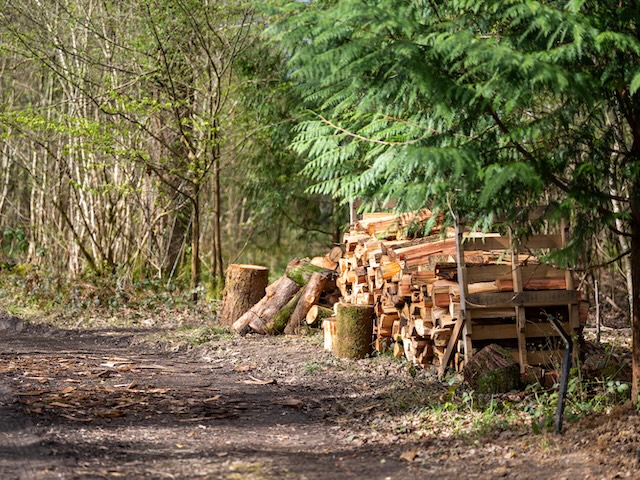
Half a planet away, at Hazel Hill Wood — home of the Regenerative Design Lab — we have just been granted our new forestry licence.
After having lapsed for a few years, this gives us permission to fell trees as part of a longer-term shift: from areas of single-species forestry to mixed, resilient woodland.
But here’s the catch.
Timber ‘in the round’ — unsown — has very low value. Often not enough to cover the cost of felling and extraction at small scale.
But as I learnt in Canada, cutting the wood into planks significantly increases the sale value of the timber.
And so an idea was born. What if Constructivist set up a new division, Constructivist Timber, to go into partnership with Hazel Hill to create a small, local timber supply chain?
Nothing large-scale, nor industrial. Just enough to process timber into usable planks, for use on site and then for sale is a modest revenue stream?
In regenerative design we often talk about unlocking stacked, multiple benefits in a system. This ideas seems to do that:
- Thinning plantation stands supports the shift to mixed woodland.
- Timber becomes both fuel and building material — reconnecting the charity to its own resources.
- Skills and craft knowledge could begin to circulate locally.
- The Lab gains a way to practise continuous place-based design — not just talk about it.
At Hazel Hill Wood, this approach also reconnects something that had quietly drifted. The earliest buildings on site used timber from the wood itself. More recent construction has relied on commercial supply chains. Re-establishing an on-site timber flow brings that relationship back into view.
How we live with trees becomes part of the lived experience of the place.
So the next logical step was clear: invest in a mobile sawmill.
And then two remarkable things happened
A local natural artist, Zac Newham (natural-art.uk) asked if he could store his mobile sawmill on site in return for us being able to use it.
And the Engineering Club asked if it could book the wood to run its summer school, in which engineers will use timber from the wood to build infrastructure on site.
It feels like by joining the dots we are already starting to unlock something abundant.
The first chapter of Constructivist Timber begins.