
Turning the Kalideascope — generating ideas for regenerative infrastructure

In yesterday’s post we looked at mindsets that might shape a brief for regenerative infrastructure

But once we have the brief established, the next challenge is to have ideas. This where we use our Kalideascope model for idea generation. 

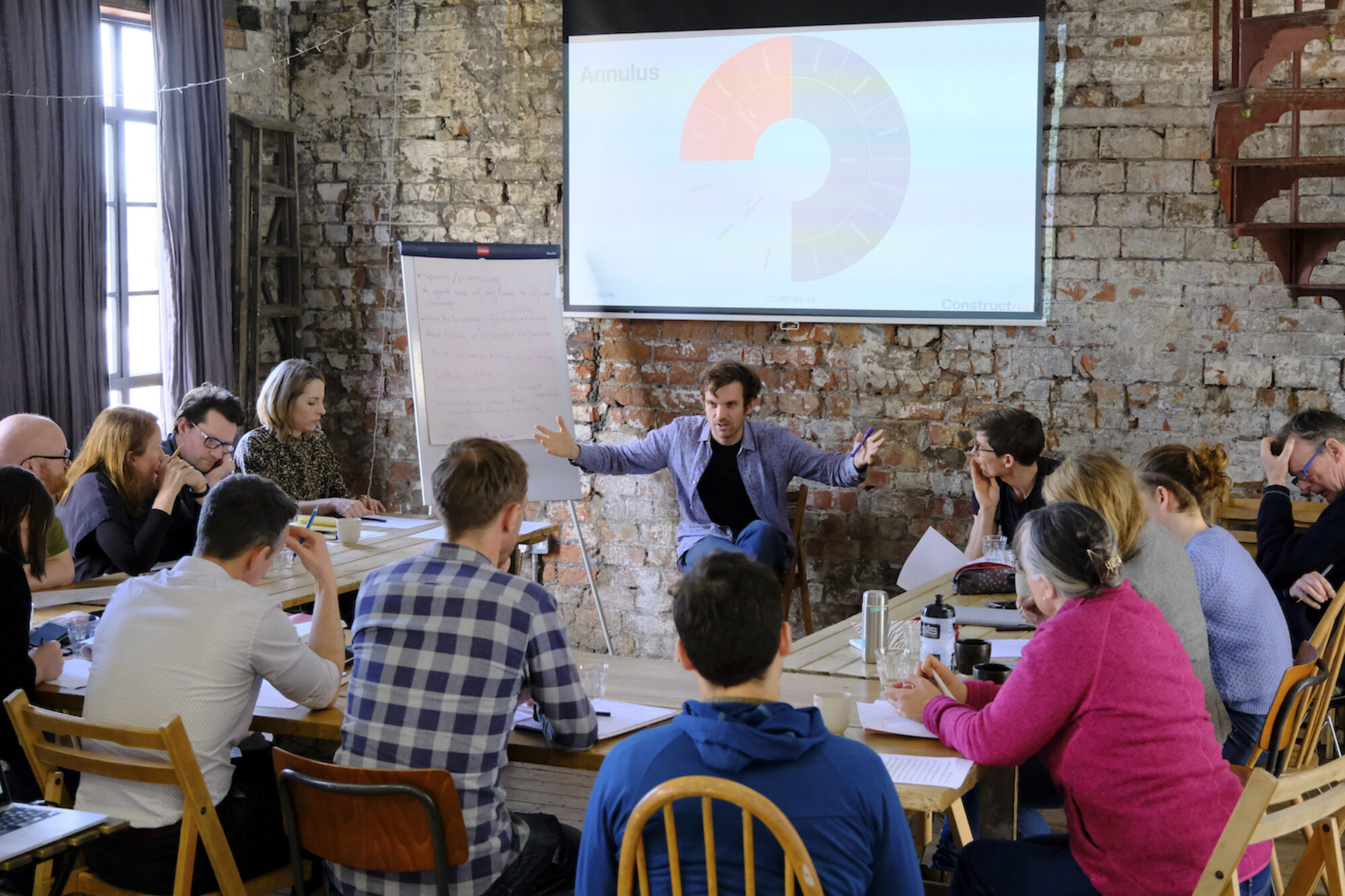
The Kalideascope is protocol engineers (and other humans) can use to develop ideas. The concept is to gather fragments of information that will inform the process (filling the Kalideascope) and then trying different combinations of these fragments (turning the Kalideascope).

For regenerative infrastructure, I see three libraries as useful inputs to the process. 

Library 1 – resilient system architectures

This first library contains examples of patterns of resilient systems. These are about how systems are structured.

In my work I draw heavily on the systems patterns described by Donella Meadows and David Fleming in their respective books, but you can build your own. 

Recurring patterns include: 

They say nothing about how they interact with the living world — this library is about form. But they give us clues about how regenerative infrastructure would need to operate. 

The job of the regenerative infrastructure designer is to fill their scrapbook with examples of these systems in order to feed them in to their idea generation process

Library 2 – systems of ecological participation

This second library contains ways for working with and enhancing ecological systems. These say little about system form.

Recurring patterns include: 

  • Nature corridors
  • Wetland restoration
  • Continuous-cover forestry
  • Patchwork landscapes
  • Ocean reforestation
  • Re-naturalising river channels

These are ways that engineers work with living systems to improve them as nodes, networks and entire ecological systems. 

Alongside Library 1, Library 2 fills our creative process with ways to intervene.

Library 3 – mindset prompts

The first two libraries help fill our Kalideascope. This third Library is a set of prompts to help us turn it — recombining patterns in different ways to create new ideas. 

This library of prompts comes from the mindset shifts in yesterday’s post.

  • What if the living world were the primary infrastructure?
  • What if everything could emerge from the living systems here?
  • What if we allowed this system to evolve?
  • What if mutual thriving were the goal?
  • What if 90% of resources had to stay in the bioregion?

These questions trip us out the rut of conventional thinking. The first responses to these questions are often not usable, but in the kernel of the ridiculous might be something that is possible.

Turning and testing

We can start to generate new ideas by combining patterns from Libraries 1 and 2 and using Library 3 to provoke further variations. 

Of course, not every idea will be good. But that is not the point. We need to generate a wide range of options to see what is possible. 

Earlier in this series, I introduced three tests for regenerative infrastructure:

  • Metabolism – does the infrastructure contribute to a system that operates within ecological limits?
  • Ecological participation – does it support living systems?
  • Resilience – is it will structured?

We can test our ideas against these criteria, and keep on turning the Kalideascope until we find something that passes.

Designer’s Paradox

The concept of regenerative infrastructure is probably unfamiliar to most of us, which makes it hard to define a brief in the first place. 

But remember the Designer’s Paradox. You don’t know what you want until you know what you can have. 

Turning the Kalieascope provokes to think about what is possible so that we can start to think about what we can have.

Is infrastructure alive? — Three mindsets shifts for regenerative infrastructure design

One of my favourite books of 2025 was Robert MacFarlane’s Is a River Alive? and it has been at the forefront of my mind as I try to do the mental work of climbing out of my conventional thinking to imagine what regenerative infrastructure might mean.

Ultimately, it comes down to mindset.

Before we get into the design brief for regenerative infrastructure, it is important to think about the mindset we are bringing to the whole process. 

In the Systems Bookcase, mindsets sit above operational requirements and designs. They shape those requirements, from which everything else follows. The mindsets in turn follow from our goals. 

In regenerative design our goal is for humans and the living world to survive, thrive and co-evolve. 

The trouble with mindsets is they can be hard to see. They are often implicit in the operational requirements that we derive and the designs that follow.

For example, if we can have sustainable add-ons to a project that is inherently not sustainable — like a low-carbon airport terminal — it suggests that the overarching mindsets and goals are not aligned with creating thriving. 

But if we can ask questions that challenge our mindsets right at the start of the project, we can make those mindsets visible before anyone has even realised they are shaping the design.

The Pattern Book proposes three mindset shifts that support a transition to a regenerative economy: 

  • From separation to interdependence
  • From scarcity to abundance
  • From control to emergence

Each of these shifts can be turned into a provocative design question for infrastructure. These questions come before we establish the design brief. They help establish the big questions about what we should be designing and why.

Interdependence – the living world as infrastructure.

Instead of asking, how do we make this infrastructure more sustainable, we ask:
What if the living world were the primary infrastructure?

Rivers, oceans, wetlands, mycelium networks, woodland canopy and the air that surrounds us. These are the nodes and connections of our living planet’s circulatory system.

Instead of designing human infrastructure first and then off-setting its effects, we could start by understanding what ecological processes sustain a place. How do rivers, wetland and coastal systems need to evolve? How do habitats need to adapt. What is needed to enable circulation of water, materials and nutrients?

We then design human systems to be nested within these living systems, and not the other way round.

Abundance – thriving living systems creating wealth

Many industrial systems are occupied with extracting increasingly scarce resources. But living systems have the potential to create huge abundance.

When they function well, living systems create huge wealth:

  • Natural cooling from tree canopies
  • Rich and diverse plant and animal life on land
  • Diverse and plentiful life in the seas
  • A microbial environment that supports our own microbiome
  • Vast amounts of materials that can be harvested
  • Natural cleaning of air and water
  • And ultimately the a complex system of interacting processes that maintain a balanced climate on earth.

Our greatest preoccupation should be how do we enable these living process to function well so that we can live well.

The design question is then not how do we create infrastructure that maximises the extraction and transport of these resources, but rather how do we create infrastructure that supports living systems to create abundance?

Emergence – living infrastructure that evolves.

Conventional engineering assumes infrastructure to be fixed, but the infrastructure of the living world behaves differently – it is alive, it shifts, it adapts to changing environmental conditions.

Rivers shift course. Wetlands expand and contract. Forests shift their make up over a cycle of many decades. Migration routes divert when they need to.

These circulatory systems are a dynamic web that shift across and shape the landscape.

Rather than attempt to control and pin down these systems, the design question becomes how do we restore the capacity of these systems to organise themselves?

Because when these systems function well, we can live well.

Questions to unlock design

These questions are deliberately provocative. The don’t have easy answers we can point to.

That’s the point of design. If we knew the answer before we started, we wouldn’t be doing design — we’d be shopping.

Regenerative infrastructure is, ultimately, the wiring of an economy that creates thriving. If we go into infrastructure design with the assumptions of an extraction-based economy, we will reproduce that system.

But if we question our mindsets, we change assumptions and open the possibility of designing something fundamentally different.

So is infrastructure alive? 

Obviously the concrete, steal and mineral structures that we traditionally build are not. 

But if we step back and ask what broader systems actually enable us to live well, the answer is very different. 

Regenerative design begins by recognising that humans and the rest of the living world must survive, thrive and evolve together. Ours and nature’s systems are not separate — they are interdependent.

That is not how infrastructure is traditionally imagined.

But the first step in designing a viable alternative to is to imagine it. 

Seeing infrastructure as alive, and part of a much wider web of life, is an invitation to imagine things differently, so we can start designing differently.

Smoothing things out

One of earliest childhood memories of travel is riding in the back of the car driving along a motorway in mountains in the north of Italy. To traverse a terrain of deep valleys and high ridges the engineers had taken a midline. The road leaps across the ravines on high viaducts, plunging straight into a tunnel only to fly out again across the next bridge. With the sea glistening deep below it was an exhilarating journey. (Did this sow the seed of going into civil engineering?)

Faced with a series of peaks and troughs the engineers flattened the journey. They saved journey time and energy on every single car journey on that route, every day for over half a century.

Smoothing things out is something that engineers seem to be generally good at. For example we’ve been straightening rivers to make them more navigable for centuries. 

But building faster, straighter roads also increases traffic. Straightening rivers increases flood risk. 

When we start to consider the unintended consequences smoothing things out we might find that working with the ups and downs and twists and turns is better. The friction slows down the flow. People or water, in these examples, spend longer in each place. There is greater interaction and opportunity exchange and creation of wealth in its many forms.

Next time I cross the Italian Alps hopefully I can do it on a bicycle, following the contours of the river valleys.

This post originally appeared on eiffelover.com in 2024.

Beavers

Whenever we ask the question, “What if every time we built something, the world got better?” — my mind jumps to beavers.

Beavers often catch the imagination of people interested in regenerative design because they show how one species, while meeting its own needs, can have a disproportionately positive impact on their environment.

In the UK, beavers were hunted to extinction, but where they are reintroduced they are creating stacked, multiple benefits in their ecosystems. To protect their homes — or lodges — beavers dam rivers to raise the water level, creating a defensive moat. To build these dams, beavers fell trees, remove their branches, drag them into the riverbed and hold them down with mud and stones. Incredibly, where the trees are too far away for them to be moved, beavers have been seen to dig a canal which they then use to float their materials to site.

Where beavers build their dams, aquatic and invertebrate life goes up. The flow of water is slowed and downstream flooding is reduced. The land around beaver dams stays wetter, which increases the amount of carbon dioxide it can sequester. In droughts you can see from the air where beavers are active — these are the places that stay greener for longer.

Beavers are examples of what ecologists call a keystone species — leading to a massively positive impact on their ecosystems.

It is ironic that where once we hunted them to extinction, we are now inviting them back to manage our flood defences and increase the resilience of our living systems. I wonder who they’ll invoice?

This post is an extract from the Motif Library in the Pattern Book for Regenerative Design. 

The song of the river

In this sequence of posts I’m collecting questions that can help me build a regenerative design palette. In regenerative design we use the living world as a design guide. This goes beyond mimicking living forms — beyond biomimicry — to understanding how  underlying systems work, the processes that give rise to form and that enable living systems to thrive in balance. 

Next on my list: how is information stored in this system?

We often think of information as facts or data — something that can be written down or recorded. The invention of computer memory, which stores information in sequences of ones and zeros, exerts a powerful influence of cultural understanding of what information is.

But the Oxford English Dictionary entry for information includes other definitions that can broaden our understanding and what we look for in living systems.  Information can also be what is expressed or represented by a particular arrangement or sequence of things.

DNA is perhaps the living world’s most impressive information code, with a base of four rather than our binary two. But this is only the starting point for thinking about natural memory. 

Tree rings store the story of rainfall and prevailing wind. Wider rings correlate with wetter years; asymmetric ones show the dominant direction of wind. And at a larger scale still, information sequences are also expressed in the shape of the hills, storing information through their form about the sequence of geological events over hundreds of thousands of years. 

At the Regenerative Design Lab, Bill Sharpe offered a beautiful way to think about this. In any system with flow, there are structures that shape the movement — like a river’s banks. But the flow is also shaping the structure — the water gradually re-sculpting the path of the river. 

I think of the river as a stylus. The banks are the groove of an LP. Together they play the song of the river.  A record of what has been played before — one that is updated with every performance. 

Our ecosystems are a rich record library of everything that has happened in a place. What happens, what used to happen, what no longer happens, what could happen again.

Information in genetic bases, in strata, in layers of growth, in physical form, in ways we are only beginning to notice, and I’m sure in many more that we haven’t.