
Building repair infrastructure

Here are my working thoughts on United Repair Centre, one of the organisations I met at the Future Observatory event The New London Commons: Circular Hubs for Fashion and Construction.

This organisation does not just do repair.

They are building the infrastructure that makes repair possible — at scale — in the fashion industry.

A rich example of both an organisation aiming higher in the system, and the Living Systems Blueprint in action.

In my post earlier this week on steel reuse, I wrote about the emergence of a new ‘blue book’ on the operations shelf of the Systems Bookcase. This is about new operational systems: 

  • Recovery processes
  • Coordination between demolition and construction
  • Storage and logistics
  • New roles and responsibilities

None of this is visible in the final building — it is the hidden infrastructure that enables reuse to happen. 

It is very interesting to see how United Repair Centre is doing taking a similar approach in fashion. 

What’s particularly striking about their work is clearly it reflects the Living Systems Blueprint in action, building:

  • Interconnection
  • Symbiosis
  • Capacity to change

Interconnection

At a materials flow level, there is the connecting together of a waste stream with an input stream. 

But that means connecting many more stakeholders: 

  • Customers
  • Brands
  • Repairers
  • Logistics

And rather than disposable clothing from anywhere and thrown away to anywhere, their work reconnects people with the things they own and the people who repair them.

That is interconnection at many levels. 

Symbiosis

Turning a waste stream into a value stream is only the beginning.

From this, positive feedback loops can start to build.

Repair creates demand for skills.

Skills create livelihoods.

As repair becomes visible and valued, the perceived value of repaired goods increases.

Each part begins to reinforce the others.

This is a fascinating collective reversal of entropy — materials becoming more valuable over time through how we organise ourselves to work with them.

Capacity to change

By running a repair skills academy, they are not just building a pipeline — they are increasing the system’s ability to evolve.

Repair skills are adaptable and transferable.

And there is a learning loop between repairers and designers, enabling garments to be designed for repair from the outset.

This is not just a system that produces outputs.

It is a system that builds its own capacity to change.

There is an interesting difference from the steel case. In steel reuse, the enabling infrastructure remains largely invisible. Here, repair is made visible — badges, stitching, signs that say ‘repaired’.

Making repair visible shifts it from stigma to pride. And at that point, we are no longer just working on operations.

We are working on mindsets.

A process for processing processes

Processes make life easier, help us involve more people, guarantee quality and conserve our attention for other things. But only if they work. 

The first time we do something, part of the work is figuring out how to do it all. If we are likely to that thing several times, figuring out a process means we don’t have to make those decisions every time. 

Creating a process also helps other people over the activation energy hurdle and, where questions of quality or compliance come in, give us a way of making sure it is done properly And this work invested in creating a process frees up cognitive load to think about other things. 

In a sense, we relinquish our autonomy to processes for the benefits they yield. But when the process no-longer provides those benefits, it starts to cause problems. 

If for instance the circumstances in which the process was created has changed, but the process stays the same, then it becomes an ill-fitting glove on the hand of someone trying to take action. It constrains us, it is uncomfortable and we are constantly aware of it.

Things become worse when you don’t have a choice — when your organisation has told you you have to use this process. Then you no-longer feel the benefit of the loss of autonomy — it becomes a burden. And this can quickly lead to cynicism. 

So what can you do? I see three levers: improve, remove or emphasise. 

Improve — if that process is there to do work for you, but is no-longer doing its job, then make it work. This requires new up-front energy to reap down-stream reward. You may not want have to do this work, but the conditions have changed and you’ll continue to pay the price until you update procedures. A badly fitting process creates friction every day, which is energy sapping. If you are in a position of authority, then you hold responsibility for the processes your staff are obliged to work with. 

Remove — it’s much more common to add processes than take them away. Lean thinking in process design is all about stripping everything and then building back up with the essentials that do just enough to create a good product, whatever that might be.

Emphasise — and if you are stuck with the process, as many in larger organisations will be, then emphasise the value that the process is creating. If it generates data, make that data visible and valuable to the people using the process. If it helps keep people safe, then emphasise that message less it gets lost and then ignored. 

Improve, remove, emphasise. You could think of this as a process for processing processes.

On a new term and the Three Horizons pencil case

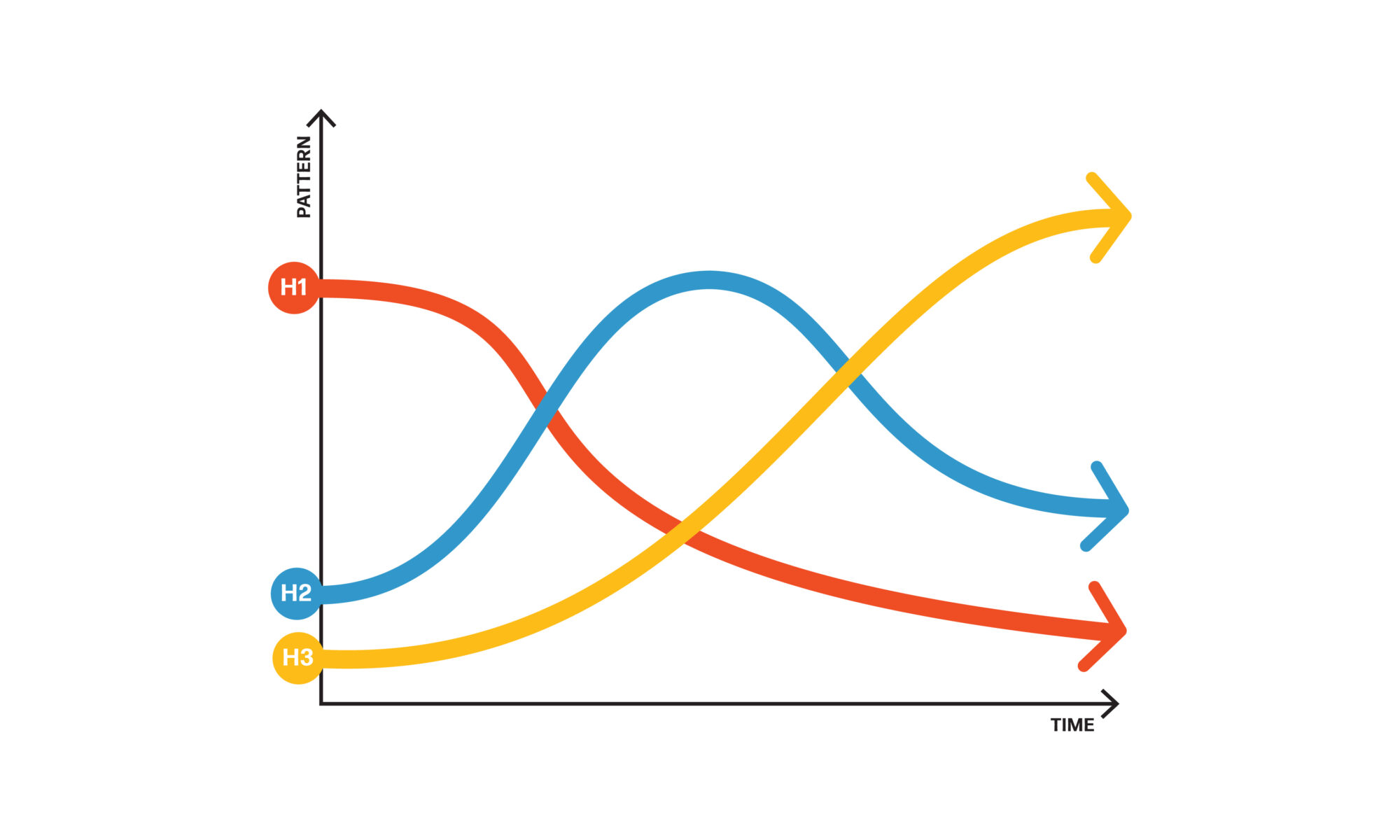
Diagram of the Three Horizons model with three overlapping curves labeled H1 (red), H2 (blue), and H3 (yellow), showing how different patterns rise and fall over time.

It is hard to escape the idea that September is a new year. It’s a time for new stationery and new intentions.

But when resolutions for the year ahead crop up, the Three Horizons reminds me that what appears new was set in motion a long time ago, what is current will not last and what we do now sets the seeds for the future.

There is in fact very little that can be decided now; that can be implemented suddenly from here on. To do so is to shock the system. It can look effective but it can cause hidden stresses as things bend to your will. Often we can only sustain this pull into the opposite direction until the yoke of the system pulls you back in its direction.

What the Three Horizons shows us is that in fact everything is in flow. What’s better is to work with the currents of change, to notice trends, to know your destination and to seek to steer things in that direction over time.

In the Three Horizons pencil case, 

  • The red pen is for what is current that will decline. In the season ahead, some things will give way. These are things that may have run their course or that have become unstable. 
  • The blue pen is for the incoming — that which is taking the place of what is in decline. It is recognisable but it is different; it has been growing for some time; and it is distinct in some way that makes it more suited to the year ahead. 
  • And the yellow pen is for what we are planting now and what is slowly awakening that will take the stage next. 

In every new season, we can see the red pen that’s beginning to run out of ink, the blue pen getting to flow and the yellow pen beginning to make its mark.

The work of change is daily work — not a single decision on the eve of a new cycle but an ongoing act of noticing what’s in decline, what’s emerging and thinking about where to make your mark.

Diagram of the Three Horizons model with three overlapping curves labeled H1 (red), H2 (blue), and H3 (yellow), showing how different patterns rise and fall over time.

Check out the Three Horizons in our new Tools for Regenerative Design page.

Letting things done

Anyone into productivity books will probably be familiar with the classic Getting Things Done by David Allen. It’s a book title that transcends the book —it becomes a value system. Done things are good things. Undone = unorganised.

So here are three alternative work modes I’ve been playing with:

Letting things done

This mode is for going with the flow — doing what needs doing in the moment. It’s a way of working that responds to feedback from your environment, especially your connection with others. It is about noticing what signals say more of this and less of that.

Doing things fun

This mode is the of energy flow. When things are enjoyable, it mysteriously unlocks hidden energy. ‘In every job that must be done, there’s an element of fun, you fine the fun and… the job’s a game’, or so said productivity consultant Mary Poppins.

Letting things go

This mode is for the work of relinquishing control. It is letting something go. It is exchanging with others. It is opening the work up to reciprocity. You have to breathe out in order to breathe in again. It’s the same with plans and ideas.

So we have:

  • Getting things done
  • Letting things done
  • Doing things fun
  • Letting things go.

Whereas getting things done signals our intent to exert our will, the other three signal working with interconnection, following available energy and emergent potential. It’s a nice map onto the Living Systems Blueprint:

  • Interconnection (letting things done)
  • Symbiosis (doing things fun)
  • Capacity to change (lettings things go)

As far as we are aware, humans are the only species that produce productivity text books. The other species just to seem to get on with it, using the resources available to them to live in harmony. Now, that’s the productivity book I want to read.

On packing cubes and better fit

Fold everything up and put it straight in the bag? Or fold everything into packing cubes first, then put these in?

Not an important dilemma — but useful for thinking about utility and fit.

Packing cubes make it easier to find your stuff. That’s a win for utility. But they make it harder to use space efficiently. That’s a loss of fit.

When you pack directly into the case, clothes can mould to the contours of the bag. With cubes, you’re first fitting clothes into rigid boxes, then trying to fit those boxes into the bag. The bigger the chunks, the less well they fit.

Even cubes designed for your bag add extra cell walls. It’s more work to get everything in.

Why does this matter? Because it’s all about equilibrium. The more options a system has, the better it can settle into a state that fits its surroundings.

Of course, both bags — with cubes and without — are at equilibrium once zipped. But cubes trap the system in a constrained equilibrium: ordered, but with wasted potential (unused space). Without cubes, the system has more freedom to find a messier equilibrium that actually fits better.

And there’s entropy at play: to keep clothes in neat cubes takes extra work. Left free, they tumble into arrangements that fit themselves.

From a regenerative point of view, sometimes it’s worth adding structure — boundaries, hierarchies, rules — to make a system function. But structure always reduces adaptability. Keeping a system in a fixed order takes work, and wastes some of its potential to respond.

So the design question is: when is it worth doing the work to hold things in order, and when is it better to let the system find a looser, but better-fitting arrangement?

The Entropy Bus

When strangers get on a bus, they almost always spread out. Few people sit next to each other unless they really have to.

Partly that’s social norms. And partly it’s probability — and entropy is the name we give to it: the measure of how many possible configurations a system can take.

The social rules push people apart, but entropy makes the scattered state the most likely outcome.

You could put an extra conductor on the bus to tell people where to sit, filling rows neatly from the front. But that takes energy. Take the conductor away, and inevitably everyone spreads out again.

The lesson of the entropy bus is that order is costly, disorder is cheap — and dispersal from order to disorder creates a flow.

The art of regenerative design is to shape systems so that the most likely outcome, and the flow in that direction is also the most life-giving.

Systems Survey

This motif combines the Living Systems Blueprint with a civil engineering perspective to create six questions for a site investigation that can reveal the underlying system characteristics.

  1. What is connected and what is separated?
  2. What is thriving and what is in decline?
  3. What is in flow and what is static?
  4. What is changing and what is fixed?
  5. What stories does this place tell?
  6. What is the place trying to do – and what helps or hinders it?

User guide

  • Site survey — use these questions to bring a more systemic lens to a traditional site survey.
  • System investigation — use these questions to think more about infrastructure and policies and how they relate to the patterns they create on the ground.

This post is an extract from the Motif Library in the Pattern Book for Regenerative Design

What if we got all the designers together who ever designed a place?

Imagine gathering every designer who has ever shaped a single street for a retrospective design crit?

Every building — from the latest new-build to the medieval cottage still standing.

The streets, the services, the flood defences.

All the engineers (and other humans) who made all the decisions.

What would they discover about their design choices?

What would they regret?

Which decisions would they make again?

What patterns of place might emerge — the things that repeatedly work (or fail), whether we choose to notice or not?

What changes might they observe?

How differently would the place sound to different generations of designer?

And how would they all arrive?

It feels like engineers (and other humans) are constantly redesigning places.

But how do we take the long view?

How do we learn from what has worked — and what hasn’t — over time?

So that from generation to generation, we build a progression of holistic wisdom, not just another round of reinvention.

The song of the river

In this sequence of posts I’m collecting questions that can help me build a regenerative design palette. In regenerative design we use the living world as a design guide. This goes beyond mimicking living forms — beyond biomimicry — to understanding how  underlying systems work, the processes that give rise to form and that enable living systems to thrive in balance. 

Next on my list: how is information stored in this system?

We often think of information as facts or data — something that can be written down or recorded. The invention of computer memory, which stores information in sequences of ones and zeros, exerts a powerful influence of cultural understanding of what information is.

But the Oxford English Dictionary entry for information includes other definitions that can broaden our understanding and what we look for in living systems.  Information can also be what is expressed or represented by a particular arrangement or sequence of things.

DNA is perhaps the living world’s most impressive information code, with a base of four rather than our binary two. But this is only the starting point for thinking about natural memory. 

Tree rings store the story of rainfall and prevailing wind. Wider rings correlate with wetter years; asymmetric ones show the dominant direction of wind. And at a larger scale still, information sequences are also expressed in the shape of the hills, storing information through their form about the sequence of geological events over hundreds of thousands of years. 

At the Regenerative Design Lab, Bill Sharpe offered a beautiful way to think about this. In any system with flow, there are structures that shape the movement — like a river’s banks. But the flow is also shaping the structure — the water gradually re-sculpting the path of the river. 

I think of the river as a stylus. The banks are the groove of an LP. Together they play the song of the river.  A record of what has been played before — one that is updated with every performance. 

Our ecosystems are a rich record library of everything that has happened in a place. What happens, what used to happen, what no longer happens, what could happen again.

Information in genetic bases, in strata, in layers of growth, in physical form, in ways we are only beginning to notice, and I’m sure in many more that we haven’t.

Six foot slugs

I get asked this question all the time. I present an example of a scheme or an initiative in which engineers have developed a glimpse of the future — a way to work with reclaimed construction materials, to work with place, to create a system of working that demonstrates how to build a thriving future. 

And then the question — how does it scale up?

This question of scaling makes sense in our parallel human-superimposed world of extraction, refining, manufacturing, distribution and assembly. In which the way to scale up is to build bigger, systems of supply.

But it doesn’t make sense in the living world.

In my garden, slugs are enormously successful. Somehow they have found a way to tough out the winter, and wait until the moment when the ground is wet enough, and then zoom up the stems of my runner beans and strip them.

Love them or loathe them, slugs are a great design. 

But in the living world, there isn’t a venture capitalist saying ‘lets 10x these slugs. I see the potential for 6 foot slugs’.

Instead, over time, living systems tend to grow in number and variety of systems. In other words, more slugs and more of lots of other things too.

It’s not so much a scale up but a diversify up. Each of these elements in relationship to each other. 

The question for the regenerative designer shifts from how do we scale up to: how can we allow the number and variety of local elements to grow and evolve?

In other words, from scaling up to creating a widening mosaic.