Building repair infrastructure

Here are my working thoughts on United Repair Centre, one of the organisations I met at the Future Observatory event The New London Commons: Circular Hubs for Fashion and Construction.

This organisation does not just do repair.

They are building the infrastructure that makes repair possible — at scale — in the fashion industry.

A rich example of both an organisation aiming higher in the system, and the Living Systems Blueprint in action.

In my post earlier this week on steel reuse, I wrote about the emergence of a new ‘blue book’ on the operations shelf of the Systems Bookcase. This is about new operational systems: 

  • Recovery processes
  • Coordination between demolition and construction
  • Storage and logistics
  • New roles and responsibilities

None of this is visible in the final building — it is the hidden infrastructure that enables reuse to happen. 

It is very interesting to see how United Repair Centre is doing taking a similar approach in fashion. 

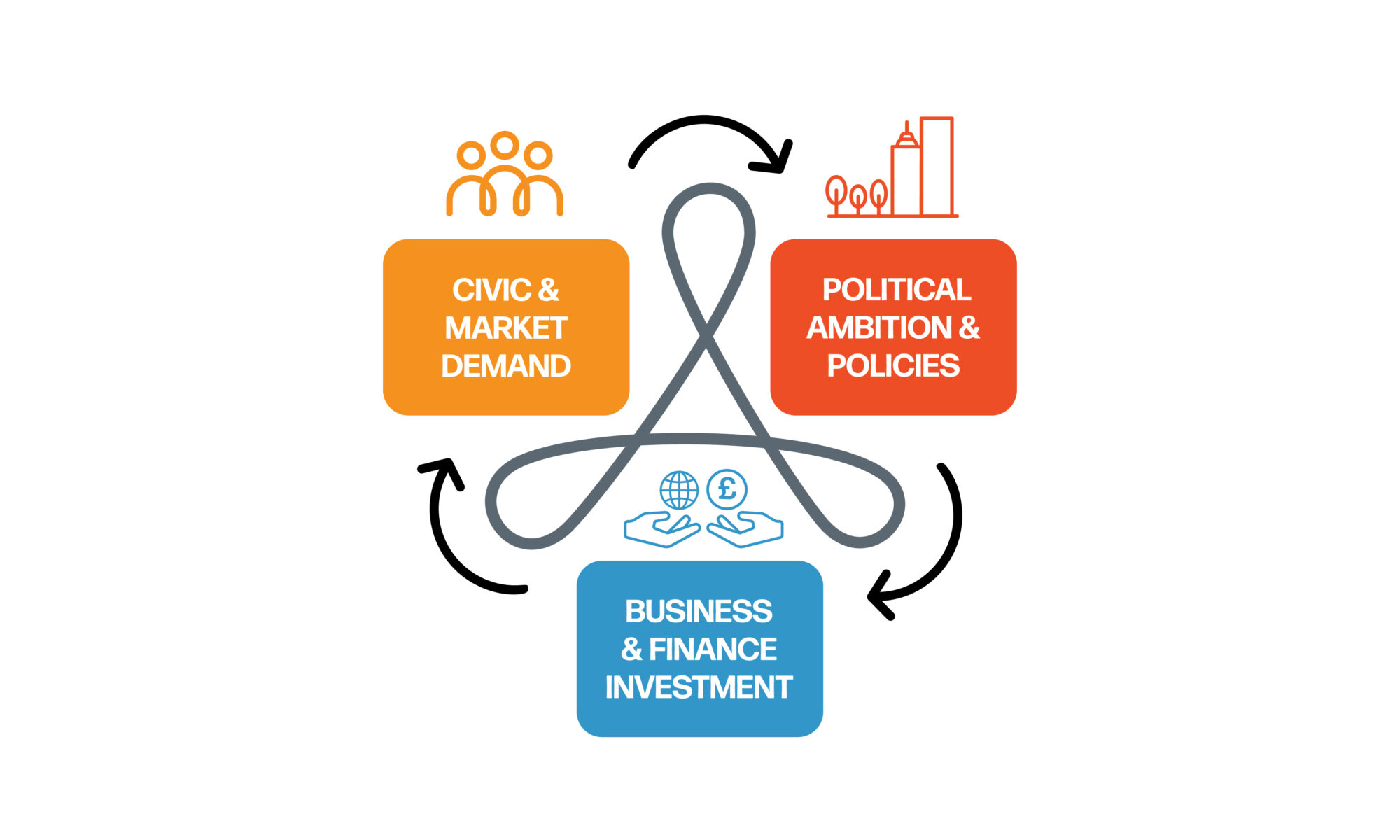
What’s particularly striking about their work is clearly it reflects the Living Systems Blueprint in action, building:

  • Interconnection
  • Symbiosis
  • Capacity to change

Interconnection

At a materials flow level, there is the connecting together of a waste stream with an input stream. 

But that means connecting many more stakeholders: 

  • Customers
  • Brands
  • Repairers
  • Logistics

And rather than disposable clothing from anywhere and thrown away to anywhere, their work reconnects people with the things they own and the people who repair them.

That is interconnection at many levels. 

Symbiosis

Turning a waste stream into a value stream is only the beginning.

From this, positive feedback loops can start to build.

Repair creates demand for skills.

Skills create livelihoods.

As repair becomes visible and valued, the perceived value of repaired goods increases.

Each part begins to reinforce the others.

This is a fascinating collective reversal of entropy — materials becoming more valuable over time through how we organise ourselves to work with them.

Capacity to change

By running a repair skills academy, they are not just building a pipeline — they are increasing the system’s ability to evolve.

Repair skills are adaptable and transferable.

And there is a learning loop between repairers and designers, enabling garments to be designed for repair from the outset.

This is not just a system that produces outputs.

It is a system that builds its own capacity to change.

There is an interesting difference from the steel case. In steel reuse, the enabling infrastructure remains largely invisible. Here, repair is made visible — badges, stitching, signs that say ‘repaired’.

Making repair visible shifts it from stigma to pride. And at that point, we are no longer just working on operations.

We are working on mindsets.
Fuelling the Regenerative Design Lab

This March we are holding the Spring Residential workshops for Cohort 6 and Cohort 7 of the Regenerative Design Lab. Appropriately I was down at Hazel Hill Wood this weekend for the wood’s Wood Chop Challenge — the annual event that provides firewood for that heats the retreat buildings used by many groups who come to the wood to learn, including the Lab.

For me this process captures something of the essence of regenerative practice.

The firewood is both product and process.

It both meets a human need — staying warm and comfortable while in the wood. And it meets the wider need of the ecosystem through careful management of the woodland. And, what’s more, the work of producing it — felling, chopping, transporting and stacking — becomes part of the experience of that place.

In that sense the Wood Chop Challenge is a small example of what regenerative practice can look like: meeting our needs while strengthening the living systems we depend on.

You can read more about it on the Hazel Hill website here.

Incline? Uncline? Recline?

I caught myself wondering in a workshop this week, what is the opposite to decline?

Incline? Uncline? Recline?

A bit of context. I often look at places in need of repair and think why has nobody fixed that yet? Perhaps, in the past, my automatic response would have been to say because there isn’t a budget for that. And with this reflex programmed in, I stop noticing.

But for some reason I have started noticing. 

A wall needing a new coat of paint.

A planter without any plants in.

A flickering light making a place feel unsafe.

When places are uncared for, unmaintained, they go into decline. Things break, breakages create new weaknesses, which then break further. Places feel unloved, and in turn they get less love. It’s a downward spiral. 

But the opposite is also true. 

When places are cared for, are maintained, they do the opposite. Improving one thing is an invitation to improve the next. We can see love for a place and are more inclined to play our part, even if that’s just by spending more time there. It’s an upward spiral. 

One way to reverse this trend is to put more external investment in. But this money will come at the cost of another place in the system. 

The regenerative designer asks a different question: 

How can the energy and resources needed to build up a place come from that place? 

How can a virtuous spiral of local inputs and outputs reinforce itself to keep making things better, and to keep going within the limits of what that local ecosystem and community can carry?

That is the essence of regenerative design. 

To move from systems that deplete themselves to ones that improve over time. 

The opposite of decline?

Thrive. 

Letting things done

Anyone into productivity books will probably be familiar with the classic Getting Things Done by David Allen. It’s a book title that transcends the book —it becomes a value system. Done things are good things. Undone = unorganised.

So here are three alternative work modes I’ve been playing with:

Letting things done

This mode is for going with the flow — doing what needs doing in the moment. It’s a way of working that responds to feedback from your environment, especially your connection with others. It is about noticing what signals say more of this and less of that.

Doing things fun

This mode is the of energy flow. When things are enjoyable, it mysteriously unlocks hidden energy. ‘In every job that must be done, there’s an element of fun, you fine the fun and… the job’s a game’, or so said productivity consultant Mary Poppins.

Letting things go

This mode is for the work of relinquishing control. It is letting something go. It is exchanging with others. It is opening the work up to reciprocity. You have to breathe out in order to breathe in again. It’s the same with plans and ideas.

So we have:

  • Getting things done
  • Letting things done
  • Doing things fun
  • Letting things go.

Whereas getting things done signals our intent to exert our will, the other three signal working with interconnection, following available energy and emergent potential. It’s a nice map onto the Living Systems Blueprint:

  • Interconnection (letting things done)
  • Symbiosis (doing things fun)
  • Capacity to change (lettings things go)

As far as we are aware, humans are the only species that produce productivity text books. The other species just to seem to get on with it, using the resources available to them to live in harmony. Now, that’s the productivity book I want to read.

Use the water on its way downhill

Use the water on its way downhill

Gather the feedback before everyone leaves.

Capture the waste heat before it disappears up the exhaust.

Better to hear it from the horse’s mouth.

Hold the nutrients back before they are washed away down the mountainside 

Learn the lesson straightaway 

Reuse before you recycle

Sort it on the doorstep rather than at the dump.

A bird in the hand is worth two in the bush

When in doubt take the high road.

You can’t stop the waves but you can surf them.

When something concentrated disperses, it loses its potential. Dispersal is inevitable. The skill in regenerative design is to catch the potential on its way down, and cycle it into new life before it’s gone

What do they grow?

I recently revisited a childhood film favourite, The Young Einstein. It begins on a cider farm in Tasmania. One evening, our hero tells his parents, 

“I want to be a physicist.”

Dad responds, “That’s great son. What do they grow?”

Absurd fruit salad

My recent food harvesting metaphor keeps on bearing fruit!

I arrive at a workshop to see a buffet of fruit.

Tasty, but I wager none of it is local and most only half of it is in season.

So what we have is a system that is very good and delivering out of season fruit from far away while local, in-season fruit wilts on the trees.

If you were to start from a blank sheet of paper you wouldn’t design this. 

A system that is efficient and scaled up in every step. 

And absurd in its outcome.

Creating thriving from scratch

Yesterday I wrote about the seven levels of a forest garden. I learnt about these at a talk given in the forest garden at Coed Hills Rural Arts Centre. The forest garden there is a flourishing, food producing space, but it hadn’t always been so. We heard how in 2009 the garden had been a field. And so how did the field become the thriving place we see today?

I’m interested in this question because it tells of taking active measures to create flourishing places. Left to its own devices the space would have brambled over, trees would have taken root and eventually the field would have become wood. But through active intervention, the team have created a space that is more flourishing than dense woodland would be — productive and in balance with its ecosystem. 

Key early moves include designing the space for the way the light falls. Forest gardens have lots of openings to let in the light, and so this structure needs to be thought about from the start. 

Another key factor was slowing down water that would run across the site in a storm and directing it through a series of swales. This was another dramatic intervention but one that has protected the soil from erosion and created ponds and multiple habitats. 

And finally, the team spoke about the work of holding things in balance until a natural balance could be achieved. For example, until the high trees grow tall, there can be too much light and the ground level plants grow out of control. Again this speaks to an active intervention needed in the transtion from a monoculture to a thriving polyculture. 

Most of the time, when humans build stuff, we have a negative overall impact on the world. Some say the best thing we can do is to stand back and let nature do its thing. But models such as forest gardening show how we can actively work with ecosystems to meet our needs while creating greater flourishing. We need to find the analogous models in construction, for example, for sourcing our construction materials. And we need to recognise that creating these supply chains will take many years of work before they can exist in harmony. 

The Seven Levels of a Forest Garden

The following I learnt from Steve Watts, permaculture expert, during a talk he gave about Forest Gardens at the wonderful Coedfest, which he co-leads.


In a forest garden, plants and trees are layered over one another to create a growing system that is far more productive and diverse than farming a single crop on an area of land.

By stacking layers of complementary plants and trees over one another, you increase the amount of carbon that is being locked in, you increase the leaf litter that falls and so you increase the richness of the soil.

As Steve describes we can think of a forest garden has having seven layers:

  • High trees,
  • Lower trees,
  • Tall shrubs,
  • Small shrubs,
  • Ground cover,
  • Plants in which we harvest the roots, and

  • Climbers.

Each of these layers can produce food at different times of the year, and each of these layers provides a complementary role to the others. It is a beautiful model for a stacked system that is creating life. And it is a reminder that when we bring different systems together in complementary ways we can create much greater richness and diversity than we keep things separate.

The Pattern Book – a new collaborative project in regenerative thinking

Earlier this month, we unveiled the Pattern Book project, an innovative workbook designed to guide professionals in the built environment towards regenerative design principles.  The Pattern Book is the next evolution in the development of the Regenerative Design Lab.

New patterns for the future


The Pattern Book aims to be an emergent, collaborative resource, offering a collection of tools, techniques, and resources under Creative Commons.

“We see in patterns, we recognize patterns, we create patterns. To create a world in which construction brings about thriving rather than destruction, we need new patterns for thinking about how we design and build,”

Oliver Broadbent
Continue reading “The Pattern Book – a new collaborative project in regenerative thinking”