
Ripe learning opportunities from moments of transition 

Transitions are ripe moments for reflection on action.

When we’re in the flow of delivery, we rarely have the chance to pause and ask what we’re really doing or why. But transitions — a change of job, a shift in funding, or simply the end of a project — give us the opportunity.

Creating change means pushing, pulling or nudging outcomes away from their default path toward an intentional one. But while we’re in the thick of delivery, it’s easy for intentions to get blurred, or dropped altogether.

So when we pop out the other side of a period of work, it’s worth asking: what was I really trying to do, and what actually happened?

  • Here are some questions I use to harvest learning at the end of a project:
  • What did I set out to do? Even if you can’t fully recall, try to write it down.
  • What did I actually do? Not just the deliverables — think about the journey: the conversations, obstacles, and detours.
  • What were the consequences — intended and unintended? In complex systems, surprises are inevitable.
  • What advice would I give someone else setting out on the same journey? You can’t repeat the past, but someone else can build on it.

These lessons are easily lost. Once we move on, the window for reflection closes quickly. So take the time to harvest the fruits of transition while they’re still ripe.

Capitalism/woodalism

Some days I get to work in the big city; others I get to work in the woods – lucky me!

The feeling I get in approaching these two venues couldn’t be more different.

I approach the city excited by the conversations I will have, by the projects we can work on. I grew up in the city. It’s a place I love. But I also increasingly feel the scale of the place and the disconnection from what makes life like this possible.

I approach the wood excited by the calm and the sense of life surrounding me. By the lessons that I know the place can teach me. But I also know how far this place is from where big decisions are made, and far from where many people live.

For me regenerative design is about building a much stronger connection between these two worlds. From where we make and where we take so that both places can thrive.

Getting on with regenerative design

Earlier this month, the Structural Engineer magazine published a review of the Pattern Book for Regenerative Design by Eva MacNamara, Director at Expedition.

Screen shot of a book review in the Structural Engineer ,with an image of the Pattern Book for Regeernative Design on the bottom left and a by-line of the reviewer Eva MacNamara on the bottom right

What I loved about Eva’s review was the way she captured the Pattern Book in use.

Dog-eared, well travelled and always within reach for those working regeneratively — Whether that’s in your bag, on your desk, or in your lap on the way to a workshop

It is, after all, a practice guide — and practice is those regular repeated actions that make up our days. 

It complements another reflection I’ve had this week. 

As we put in place plans for our three cohorts of the Regenerative Design Lab next year, how much the dialogue has shifted since we began. Back in 2023 a lot the discussions were about what regenerative design is, how to make the case for it, looking for examples. 

Whereas now, the conversations that I hear are much more engaged in practical application. How to embed this thinking in different scenarios. How to seek out new opportunities to make change. How to weave a regenerative approach into early-stage thinking on a project?

This is about getting on and doing. 

It’s about experimenting and learning.

This is about practice. 

Just a reminder — there’s seven weeks to go until we launch our online intro to regenerative design, ‘Seeing the System’. Do let your colleagues know. Previous Lab members have a discount code that gives 20% off for their colleagues.

Pattern book field notes – action learning and continuous place-based design

The Pattern Book for Regenerative Design is propped against a sign saying keep off the grass. In the backdrop is the quad of a Cambridge college

This week I took my copy of the Pattern Book to Cambridge. (Its second visit: in July I dropped it — and my laptop — in a puddle. Both recovered, and this time was less eventful.)

I was there to deliver my annual September workshop for the new cohort of students on the Sustainability Leadership for the Built Environment (SLBE) masters at the Cambridge Institute for Sustainability Leadership. Two Pattern Book entries featured strongly.

Continuous place-based design

The workshop was called Design your learning process. We began by asking: what is design? I asked students to sketch a diagram of design as they see it.

This is central to the Constructivist method: start where the learner is, then connect new concepts to what they already know.

After sharing diagrams, I introduced a series of design models, each adding a new dimension, until we reached the Continuous Place-Based Design motif. At each stage, I pointed to overlaps with the students’ diagrams.

The point isn’t to treat any model as a strict procedure, but to use it as something to compare with reality — and then think how we might shift that reality for the better.

Action learning

From there, we turned to the idea that continuous place-based design is really a learning process. Which led naturally to the Action Learning motif.

It’s easy to be passive in learning. The real value comes when we apply theory to practice and then reflect on the results. The Pattern Book entry for action learning even includes a script for running these conversations with colleagues.

This month, I’ve been in workshops on live infrastructure projects where the same theme has surfaced again: organisations struggling to learn from mistakes. Not lessons learned, but lessons lost. For me this underlines that action learning isn’t just a training method — it’s a principle for working in complex systems.

It is such a pleasure to teach on this course — this is the start of my eighth cohort! Many graduates are readers here, so if that’s you: thank you for sticking with me all these years.

Learning as a design process

Diagram showing the cycle of Continuous Place-Based Design: Observe, Brief, Ideas, Make & Test — all centred around Place.

In a flip of yesterday’s post — if design can be a learning process, then learning can be a design process too.

What would it look like to approach learning the way we approach design?

Design begins with intention. It asks: how do I take an existing situation and make it better? That invites us to name where we are now — and to define what better might mean for us.

Design also embraces divergence. In a learning context, that could mean exploring unexpected sources, challenging the materials in front of us, or inventing new ways to engage.

Design gives a different meaning to testing. Not testing to see if I made a grade, but testing to see if I fulfilled the brief. 

And design invites us to keep coming back to the brief and ask how could the brief be improved.

By designing our learning we have the potential to not just passively follow a learning process but to create one that more intentionally meets our needs. 

Design as a learning process

Many projects treat design as a problem with a fixed answer. But what if we treated design as learning journey?

In a complex world, design needs to be a responsive process. This means observing, setting intentions, developing ideas, testing them and seeing what happens. With each iteration of this process we get a better understanding of how the system responds to our thinking — and how our thinking needs to respond to the system.

  • This mindset encourages us to:
  • Respect complexity
  • Work iteratively
  • See value not in a single deliverable, but in insight that accrues over time

It’s hard to argue with that. And yet many design processes are linear and short-term.

But just think about what long-term value could be unlocked by shifting from merely delivering an answer toward building understanding.

The dream walk experiment at Hazel Hill Wood

Last week at Hazel Hill Wood we ran a ‘dream walk’ with staff and trustees. The aim was to tune into our long-term hopes and aspirations for the site, as we continue the responsibility of creating a thriving place for care and learning.

Hopes and dreams are part of what a place is trying to do. They arise from our relationships with place and help steer the flow of change.

We began with Zuma Puma’s Box-Clearing warm-up (a technique I learnt from one of my clown teachers —more on that in another post), then set out into the woods. The rules were simple:

  • Walk to a place in the wood.
  • Walk with your gaze slightly raised to invite in fun and curiosity (another technique from another clown teacher, Robyn Hambrook) 
  • Share what you’ve always hoped for this place.
  • Imagine how it could be, how it might change.
  • Speak until you’re done.
  • The next person picks up — not to challenge, but to add their own dreams.

We captured dreams in audio and notes, later mapped across the site.

What I learnt from facilitating the process

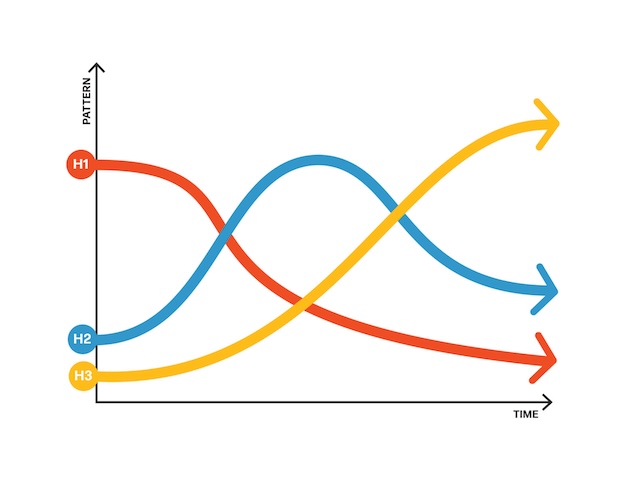
  • The temptation to say why not is strong — the delivery mindset of Horizon One is never far away. With reminders, we shifted into a more open Horizon Three frame.
  • Some dreams resonated and compounded — one voice building on the next until a vision took shape.
  • Some spots felt dream-silent, as if they were low-energy places. Others flowed with possibility, hinting at where change energy gathers. This was a real ah-ha moment for me.

This dream walk supported three things at once: observation in Continuous Place-Based Design, imagining Horizon Three in the Three Horizons model, and adding inputs to our Kalideascope

You could consider carrying out a dream walk where you are: walk, notice, and speak your dreams of place aloud. You might be surprised by what takes shape.

Consult your hopes and dreams — part of what a place is trying to do

The first stage in continuous place-based design is observation. It is a beginning that says before we do anything different here we need to try and understand this place. 

The aim of this phase is to gather as much data and wisdom as we can before proposing changes. That data can be physical, cultural or even intangible — anything that helps us to notice what makes a place distinct, what gives it its feel. 

One of the data sets I think is often overlooked — but vital — is hopes and dreams.

These are easy to dismiss as not ‘real’ but I see them as very real. Our hopes are distant but visible from where we are now — rooted both in the present and in the future. In the language of the Three Horizons Model, they belong in Horizon Three: an outline of what we see from here in the future. 

Since the design process spans the present and the future, hopes and dreams are a vital link.

The hopes and dreams of the people that live or regularly used in a space are founded in their complex interaction with that place. So asking simple questions like: 

What is your hope for this place?
What do you dream I could become?

…can a great deal about the current lie of the land and its future potential. 

One the questions we ask in the Systems Survey motif (see the Pattern Book) is ‘what is this place trying to do?’

Hopes and dreams are part of that answer. They are usually motivating — either towards one place or away from another. They inject energy into certain courses of action over others. And so that are an important clue as to what patterns are already unfolding here or are likely to in the future.

So pay attention to hopes and dreams as well as the things you can physically observe. These dreams may already be shaping the path that this place is taking.

Core tools for regenerative design now online

9 thumbnail-sized illustrated diagrams providing an over of the 9 constructivist tools for regenerative design. The tools are the ambition loop, changing mindsets, the goal of regenerative design, continuous place-based design, the living systems blueprint, the systems bookcase, the library of systems change, the three horizons and the kalideascope.

I am happy to announce that we have now published online our set of free-to-use core tools for regenerative design. These nine tools are central to our teaching in the Regenerative Design Lab

Accompanying each tool is a free-to-use downloadable image, designed by Alexie Sommer, who led the design of the Pattern Book and all our visuals at Constructivist. 

As well as the motif description from the Pattern Book, each tool has linked to it recent blog posts that relate to that tool’s function. In this way, we have aimed to create a set of core reference content that dynamically update as we conduct new experiments with these tools.

By publishing this toolkit we hope we can spread these ideas further at the same time as drawing more people into this work. So please do check them out and spread the word.